Introduction:
If it were not for Peter’s speech at Pentecost, most people would dismiss the book of Joel as an antiquated prophecy that has little to do with the church today. However, Peter made it clear that at least part of Joel’s prophecy was about the last days. “But this is what was uttered through the prophet Joel: “‘And in the last days it shall be, God declares, that I will pour out my Spirit on all flesh, and your sons and your daughters shall prophesy, and your young men shall see visions, and your old men shall dream dreams; even on my male servants and female servants in those days I will pour out my Spirit, and they shall prophesy. And I will show wonders in the heavens above and signs on the earth below, blood, and fire, and vapor of smoke; the sun shall be turned to darkness and the moon to blood, before the day of the Lord comes, the great and magnificent day. And it shall come to pass that everyone who calls upon the name of the Lord shall be saved’” (Acts 2:16-21). For this reason, it is important to take a closer look at this minor prophet.
Author and Setting:
The book was written by Joel son of Pethuel. Joel probably means “Jehovah is God.” He was likely from Judah since his prophetic utterances dealt with Judah and Jerusalem. We can deduce that he was highly educated because of his literary ability, which is considered to be equal to that of Isaiah and Habakkuk. Other than this, we know nothing more about him. It is also difficult to set a specific date for Joel. The book does not give many historical clues that would set limits on the dates of the book. He does not mention the reigning king, so commentators have speculated that he prophesied during a time when a young king was ruling under a regency and had not yet officially taken up the mantle of office. For this reason, they have set dates when there was no reigning king: the 9th century when young King Joash was under the guardianship of the high priest Jehoiada, the 7th century during King Josiah’s childhood, or after the Babylonian exile when there was no reigning king. The one great clue about the date is that it was written during a time of famine because of locust swarms and drought. However, we have no ancient historical records of this kind of disaster. Maybe someday, archaeology will shed light on the timing of Joel.
Theme:
The first part of the book is about the need for repentance because of the two-fold natural disaster facing Judah: swarms of locusts and drought. Thus, the implication is that this was not a simple natural catastrophe, but instead it was a Mosaic curse in response to apostasy. The second part of the book deals with the results of being restored to a right relationship with God and receiving His blessings.
Organization:
1:1-2:17
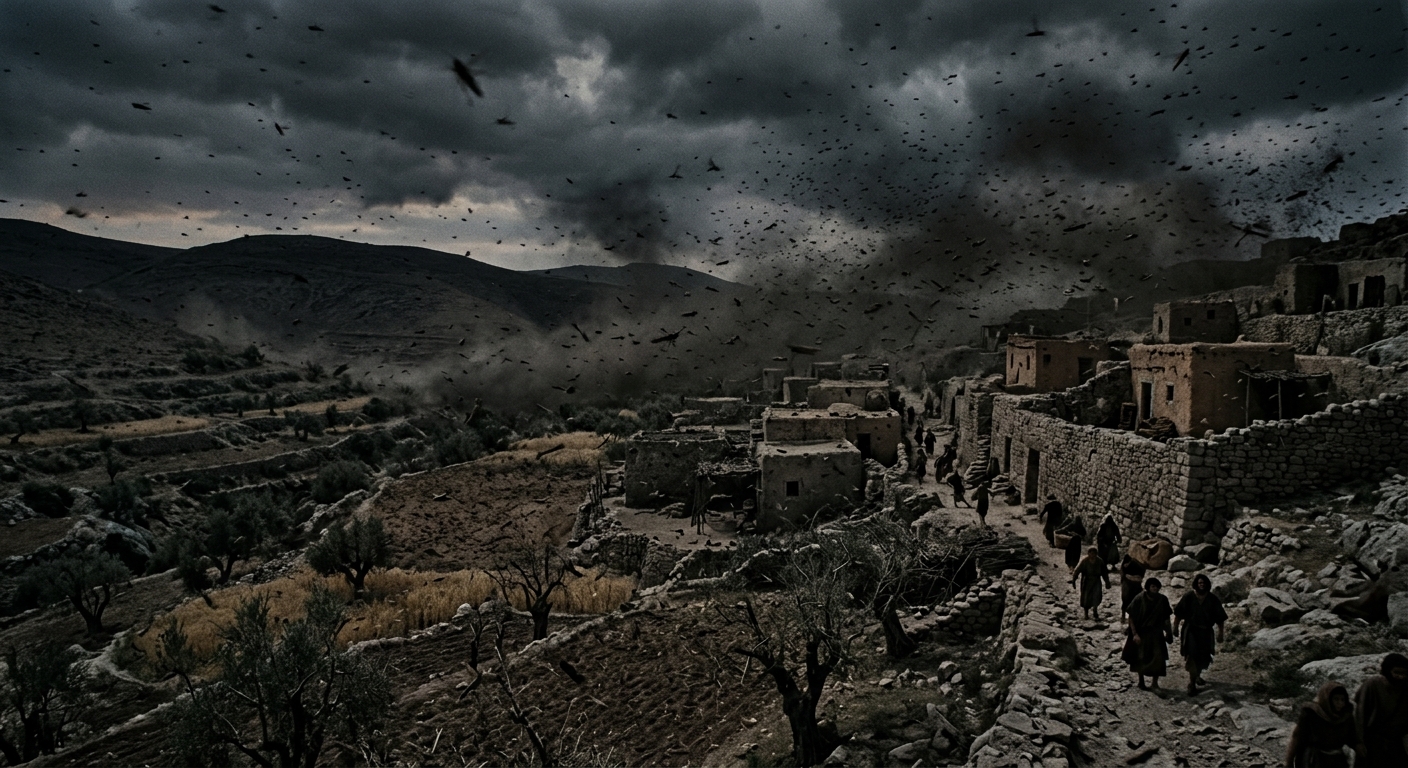
Famine from a locust plague and drought and a call to repentance. Chapter one is most likely describing a real invasion of hungry bugs such as took place in the United States in the 1930s. However, references to the locusts in chapter two may or may not be applying the symbol of hungry locusts to an invading army, such as the Babylonians. It is difficult to know without having a date for the prophecy.
2:18-27
The Lord returns His blessing to His people. He will remove the locust army and repair the damage they have caused. Verse twenty is one reason to believe that the hungry locusts are now symbols of conquering armies. “I will remove the northerner far from you, and drive him into a parched and desolate land, his vanguard into the eastern sea, and his rear guard into the western sea; the stench and foul smell of him will rise, for he has done great things” (Joel 2:20). On the other hand, this may just be a poetic reference to the bugs as an army.
2:28-32
Joel looks far into the future and foresees the outpouring of the Holy Spirit. This prophecy began its fulfillment at Pentecost as Peter announced in the book of Acts, but according to the context of Joel, the prophecy will continue until the end of time, i.e., Jesus’ second coming and maybe beyond.
3:1-16
Judgements against the enemies of God’s people and safety for those who are loyal to Him.
3:17-21
The promise of a bright future where no enemy will ever conquer again and pure water will flow from the temple of God. Compare this scene with Ezekiel 47 and Revelation 22:1-5.
Note about Spiritual Israel:
It is important to remember that prophecies involving Israel as a political entity were conditional upon the leaders’ acceptance of the Messiah. Daniel 9:24 explains that Israel had one last chance to fulfill their mission. In Acts 7, Stephen repeated the charges against Israel and gave one last appeal to the leaders, which they rejected. At this point, the promises made in the past were reserved for those loyal to the Messiah, i.e. the church. Paul confirms this in Galatians 3:27-29, as well as other places. Revelation takes these prophecies of the past and demonstrates how they fit together in a world where political Israel rejected the Messiah while individual Jews carried the gospel to the world. Read the end time prophecies of Joel with the knowledge that the church is the Israel of the last days.
Conclusion:
Joel’s answer to devastation from a natural phenomenon, such as locusts and drought, is to turn to God. Joel assures us that God will bestow His favor on His repentant people if they turn to Him. These promises still belong to God’s people today. We are living in the end times after the outpouring of the Holy Spirit. We are living in the days when there will once again be famine and war. We must listen to Joel and turn to our God in trust when enemies surround us and food becomes scarce. God will take care of His people. He has promised that better days will come for His loved ones.