Introduction:
Did the God of the Old Testament care about Israel’s enemies? Does God provide messengers to testify to those who seem irredeemable? Is God concerned for the people of all nations? The Bible provides a resounding “Yes!!!” to those questions. Assyria is just one of many nations that received warnings of the results of their sinful ways from God. Those threats were meant to bring repentance and avoid destruction. Unfortunately, too many recipients ignored the warnings. The prophecies of Jonah and Nahum are examples of a situation where God warned a cruel society of the results of their violence. Assyria responded positively to the first warning from Jonah, but about 170 years later they rejected their final warning from Nahum and were destroyed. Today God is still sending out His witnesses to violent, cruel societies calling for a change, drawing them to His love. Who will respond to His warnings and choose life over death?
Author and Date:
The author of this book is listed simply as Nahum of Elkosh. No one knows for sure where Elkosh was located, but some sources say that it was a village in Galilee/northern Israel, pointing out that the name of the town of Capernaum means village of Nahum. On the other hand, others have speculated that the town was located in Assyria. Still others think that the village was in Judah. Nothing else is known about the prophet Nahum. The date of this book is a little easier to pin down since Nahum refers to the fall of Thebes/No (3:8) as having already happened. Thebes fell to the Assyrians in 663 B.C. to King Asherbanipal. Nahum 3:7 indicates that Assyria had not yet fallen at the time of the prophet’s warning. Nineveh was defeated in 612 B.C., so some commentaries place the date of Nahum’s prophecy at about 640 B.C. during the height of Assyria’s power before the armies of the Medes and Babylonians besieged and destroyed it.
Background:
Assyria was a nation with seemingly no redeemable qualities. They were violent, bloodthirsty, and cruel, yet God had sent His prophet Jonah to warn them of His wrath to come sometime around 800 B.C., and wonder of wonders, the Assyrians believed in the power of the God of Israel and repented. Thus, began what some historians have labeled a period of decline, but what I would call their opportunity to rise. Several generations of Assyrians restrained their desire to destroy, pillage, and torture, but eventually, they chose violence over peace and began to conquer again. Finally, their time of probation ran out, and God sent the prophet Nahum a message to warn them about their final destruction. This time they did not listen.
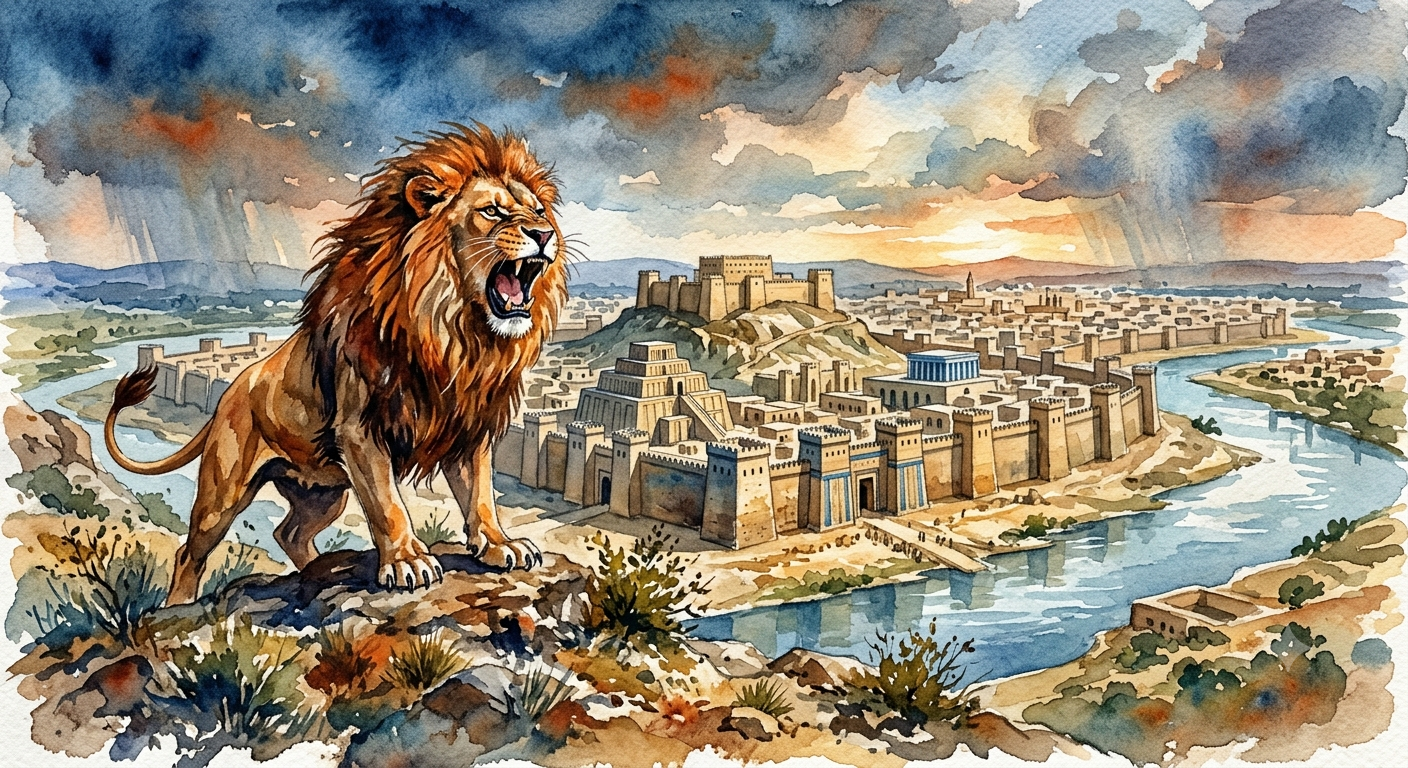
When Jonah proclaimed that Nineveh would be destroyed in forty days, the king (probably Adad-nirari III) not only believed that the God of Israel had the power to destroy his kingdom but also knew that there was a chance for mercy. Fast forward to the reign of King Sennacherib of Assyria sending his army to surround Jerusalem and his general defiantly calling out to the people, “Who among all the gods of the lands have delivered their lands out of my hand, that the LORD should deliver Jerusalem out of my hand?’” (2 Kings 18:35). A previous king of Assyria, Shalmaneser, had already conquered the northern kingdom of Israel and taken the people into exile repopulating the area with Gentile idol worshippers. Assyria no longer respected the God of Israel, and had become even more bloodthirsty, cruel, and hardened than before. In Nahum, God refers to them as vile and a bloody city and compares Assyria to a lion who has filled his den with torn flesh. This description is more accurate than many realize. Archaeologists have found Assyrian monuments that brag about displaying the skins of their enemies on walls, stacking corpses and severed heads into pillars, and cutting off body parts or burning enemies with fire. The Assyrians were proud of their cruelty. However, those who live by the sword will die by the sword (Matthew 26:52). Around 626 B.C. the Assyrian Empire began to fall apart. Babylon revolted and formed an alliance with the Medes. Together, they besieged Nineveh for three months and conquered it in 612 B.C. Thus, the words of Nahum spoken at the height of Assyrian power were fulfilled within about 28 years. The unimaginable became reality.
Theme:
One theme of Nahum is God’s power. Mountains shake, hills melt, seas dry up, and rocks break when God pours out His wrath. God is good to those who fear Him, but His adversaries will be completely consumed when He decides they must go. A second theme is Nineveh’s destruction. Nahum sees a vision of the battle and Assyria’s defeat. The conqueror will become the conquered. Nineveh’s fate is the same as the great cities that have been devastated by her. Her great men—her soldiers, merchants, and leaders—will flee from the approaching armies rather than fight. Her false gods are worthless in the face of God’s judgment.
Organization:
1:1 Introduction
1:2-11 God’s power and ability to defeat His enemies
1:12-15 Assyria is doomed and Judah is saved.
2:1-7 A vision of battle
2:8-13 Nineveh is transformed from a mighty prosperous predator to broken rubble. Everything has been
plundered. Everyone has fled.
3:1-3 Another vision of battle
3:4-10 God has executed judgment and Assyria will surely fall. Just as Assyria once conquered mighty Thebes/No
in Egypt, Nineveh will in turn fall to conquerors sent by God.
3:11-19 Assyria can make all the preparations it desires, but it cannot avoid its fate.
Conclusion:
Evil may seem insurmountable, but there will come a time of judgment. When God moves, none can stand against Him. Mighty Assyria fell; golden Babylon was conquered, and the pagan Roman Empire is no more. However, God makes a difference between the irredeemable political entities and the individuals who live within a country’s boundaries. The people of Assyria still exist today in Iraq. They are loyal to the Christian faith, which means that God sent His witnesses to these people once again, and the Assyrians listened to the gospel message and accepted it without the arrogant cruelty of their forefathers. The fall of Nineveh may have provided the best outcome possible for this group of people because Jesus will be joyfully bringing many Assyrians home to live with Him. Assyrian history reassures us that God’s judgments against evil always have the goal of saving as many lives as possible for the kingdom of heaven.