Introduction:
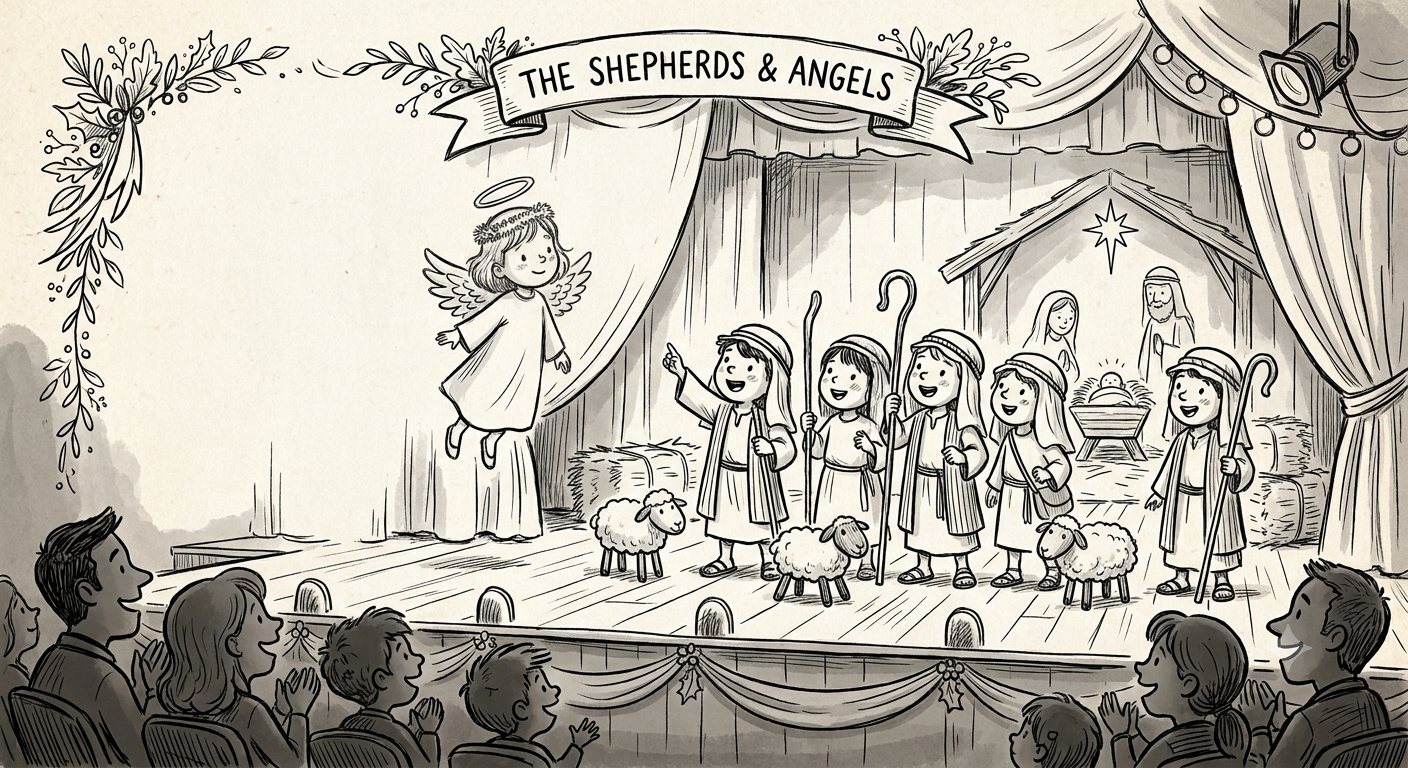
Every December in churches around the world, little kids dress up as shepherds and listen as an “angel” recites the famous words, “Fear not: for, behold, I bring you good tidings of great joy, which shall be to all people. For unto you is born this day in the city of David a Saviour, which is Christ the Lord. And this shall be a sign unto you; You shall find the babe wrapped in swaddling clothes, lying in a manger.” Then the congregations sing “Hark the Herald Angels Sing” or some similar song to act out the night sky being filled with angels praising God. As familiar as this story is, it is easy to assume that it is found in multiple places in the Bible, but in fact, we have only one source for this important announcement of the birth of the Messiah: Luke.
Author and Date:
The gospel of Luke was likely written around A.D. 60. Luke was a convert to the Christian faith from idolatry. We know this because Luke was a Gentile. In fact, he is the only Gentile author of any book of the Bible. True, Daniel includes a statement of faith from King Nebuchadnezzar, but that is only one chapter of the book. Luke wrote two whole books in the New Testament—the gospel that bears his name and Acts, which is the only history of the activities of the early church. Astonishingly, this Gentile’s writing makes up more than one fourth of the New Testament by quantity of words. That is even more than his hero Paul wrote. An ancient writer named Eusebius claimed that Luke was from Antioch in Syria although the book of Acts indicates that Luke had some ties to the city of Philippi. Luke was a physician. From this information, there is some indication that Luke may have been a slave at one time since it was common for a doctor of the period to receive his medical training as a slave of a wealthy family so that the family would have their own in-house physician. Because of his high level of training, a doctor could eventually earn enough money on the side to buy his freedom.
Finally, we know that Luke was highly literate and an excellent researcher. His vocabulary, including medical terminology, far outpaces the other books of the New Testament. His style matches that of the best authors of his day. However, it is his research that really sets him apart. He tells the reader in Luke 1:1-4 that he consulted eyewitnesses in preparing his orderly account of the life and ministry of Jesus. If he was from Antioch, he had access to many firsthand accounts of Jesus there, but it was as Paul’s traveling companion that he made contact with even more sources of information, including Mark. While they may have interacted at an earlier time, the Bible places them both in Rome during Paul’s first imprisonment (Colossians 4:10, 12). Most commentators believe that the gospel of Mark was one of the source documents that Luke used for his own gospel. Luke’s meticulous research and attention to detail has allowed archaeologists to confirm many of the persons and events in his writing. Luke provides dates based on when certain public officials held office, which has given historians greater ability to accurately date many of the events in the life of Jesus and the early church. Luke has earned a solid reputation as a trustworthy historian, as well as an inspired prophet that God has used to reach generations of children and adults with the gospel.
Themes:
The book of Luke is one of the synoptic gospels, which means that it shares a basic story with Mark and Matthew, but Luke has unique themes and content, which are not included in the other gospels. As a Gentile himself, Luke tends to emphasize that the gospel is for all people. Luke records that at Jesus’ dedication in the temple, the prophet Simeon stated that the baby would be a light to the Gentiles (2:32). Jesus marvels at the faith of a Roman centurion (7:9). Only Luke tells the tale of ten lepers being healed with only a hated Samaritan returning to give thanks (17:16) and one of the most famous and beloved parables of all—the Good Samaritan (10:30-35). Where Matthew stops his genealogy with Abraham the progenitor of the Jews, Luke extends his genealogy all the way back to the father of all humans, Adam.
Luke is also known for his focus on women’s participation in the gospel. Only he tells us of Elizabeth and Mary’s interactions before the birth of their children. Without Luke, we would not know that a number of women traveled with Jesus and supported His ministry financially (8:1-2) or Jesus’ compassion for the widow of Nain (7:11-15). Luke joins the other gospel writers to tell of the women who bravely bore witness of their loyalty to Jesus at the crucifixion even while the men (except John) were hiding in fear.
A third theme in Luke is prayer. Luke alone records the parable of the Pharisee and the tax collector (18:9-14) and the persistent friend at midnight (11:5-10) teaching us to be humble, yet persistent in prayer. Luke tells us that Jesus was praying at His baptism (3:21), before He called the twelve to be His special disciples (6:12), before Peter’s confession of faith (9:18), when He was transfigured (9:28-29), and at the crucifixion (23:46), as well as other well known prayers, such as the Lord’s Prayer and Jesus’ agony in prayer on the Mount of Olives, where He advised the waiting disciples to also pray (22:40).
Organization:
1:1-1:4 A greeting to Theophilus and statement of purpose and methodology. (For more on Theophilus, check out the background to the book of Acts.)
1:5-2:52 Luke provides background for John the Baptist. He shows the interaction between Mary and Elizabeth. Then he describes the birth, infancy, and childhood of Jesus.
3:1-4:13 Jesus’ ministry is initiated from baptism to temptations in the wilderness. Jesus’ genealogy demonstrates His qualifications for ministry. This takes place in the fall of A.D. 27.
4:14-9:17 Jesus’ ministry in Galilee, including healings, the call of disciples, the Sermon on the Plain, John the Baptist’s doubts, and parables. During this time, Jesus is rejected by His hometown of Nazareth. This section ends with the feeding of the 5,000. The Galilean ministry takes place from A.D. 29-30.
9:18-62 Revelations of Jesus—Peter’s confession, the transfiguration, and the cost of following Jesus. Jesus begins to speak of the crucifixion. A.D. 30
10:1-19:27 The teachings of Jesus including parables and the Lord’s Prayer. Jesus sends out the seventy-two. He foretells His death for a third time. This section ends in Jericho with the healing of a blind beggar and dinner with Zacchaeus. A.D. 30-31
19:28-21:38 Jerusalem—the Triumphal Entry and cleansing of the temple, challenges from religious authorities, and warnings of destruction. A.D. 31
22:1-23:56 The Last supper, prayer on the Mount of Olives, betrayal, arrest, trials, and crucifixion. A.D. 31
24:1-53 Resurrection, appearances, and ascension. A.D. 31
Conclusion:
Luke provides us with an outsider’s perspective of the life of Jesus. He focuses on ideas that would have been important for Gentiles to learn about this Jewish Messiah who came to save the whole world. Often Luke is seen as just an assistant to Paul. He is the beloved physician always pointing to others’ ministry, not his own, yet through his detailed heartwarming gospel, Luke has had as great of an impact on the world as the more famous Paul. Paul was an apostle, but Luke was a non-Jewish prophet whose inspired writings reveal the beauty of Jesus and the actions of the Holy Spirit in the early church. Luke’s life teaches us that when we humbly offer our talents to Jesus, God will use them in greater ways than we can begin to imagine.