Typology is a specific interpretation of persons, events, or institutions in the Bible that prefigure Jesus or other realities contained in the gospel.
The concept of typology comes from the language of the New Testament. Greek contains two words that theologians utilize to explain the use of symbols in the Bible. The first word is /typos/ or /tupos/ which we call the “type” in English. This is the symbol or copy of something. The second word is /antitypos/ which we call “antitype” in English. The antitype is the original or the true thing that the type has copied.
Today, I want to look at a messianic psalm of David that is an example of type and antitype. A messianic psalm is a psalm that points forward to Jesus. Typically, these psalms jump back and forth between the life of the psalmist (usually David) and the Messiah. These psalms should be read on three levels:
- How does the psalm speak about the circumstances of the original writer?
- How does the psalm point forward to Jesus?
- How does the psalm speak to you about your life today?
In the following Bible study, ask these three questions as you read Psalm 22. I have included sample answers, but you should answer for yourself before reading my answers because my answers are incomplete, and you will have valuable insights that I did not include. In addition, your experiences will make your answers to the third question unique and likely utterly different from mine. This technique can be done individually as I have demonstrated here, but I find that it is even better when used with a group of people studying a Messianic psalm together.
Verse 1 To the choirmaster: according to The Doe of the Dawn. A Psalm of David. My God, my God, why have you forsaken me? Why are you so far from saving me, from the words of my groaning?
- Who wrote this psalm? David (Be careful, not all the psalms were written by David, but this one is.) This psalm was written by David about his feelings. He was the type. However, this is also a messianic psalm written about the antitype—Jesus.
- What event in Jesus’ life is this describing? The crucifixion.
- The prophetic psalms should be read on three different levels.
- What was the author’s situation? He felt that God was not with him. He felt abandoned by God.
- How does this look forward to Jesus? In Matthew 27:46, Jesus spoke these same words from the cross, “My God, why have you forsaken me?”
- How does this speak to my life today? There are times when my pain and sorrow overwhelm me, and it seems like I can obtain no relief from my problems. I want God to take them away immediately, but He does not, and I continue in pain.
Let’s read the psalm verse by verse and answer these three questions. Sometimes, I have grouped verses that repeat the same kind of information together.
Verse 2 O my God, I cry by day, but you do not answer, and by night, but I find no rest.
- What was the author’s situation? He is in trouble or pain and praying continuously to God for relief, but he feels that God is not answering him.
- How does this look forward to Jesus? In Gethsemane, Jesus was in such agony that He sweat great drops of blood and told His disciples that His sorrow was killing Him. He cried out again and again for the Father to find another way to save humanity, but the Father did not answer.
- How does this speak to my life today? Many times, I pray for peace and relief from the problems imposed on me by other people, yet their voices resound in my head over and over again. I cry out to God for peace and joy, but the stress and hurt remain.
Verse 3 Yet you are holy, enthroned on the praises of Israel.
- What was the author’s situation? He contrasts his situation with God. As he meditates on the Lord, he sees that God is worthy of praise. He remembers that God is holy.
- How does this look forward to Jesus?In the garden of Gethsemane, Jesus declared that the Father knew everything, so Jesus trusted in the Father’s wisdom in not taking the cup of wrath away from Him.
- How does this speak to my life today? When I feel overwhelmed by the pettiness and vanity of even sincere followers of God, I look to Jesus and remember that God is different from humanity. He is worthy of praise. Then I begin praising Him and find relief.
Verse 4 In you our fathers trusted; they trusted, and you delivered them.
- What was the author’s situation? David looked back on the history of God’s interactions with his people and remembered that they also had been faced with severe trials. God came through for them every time.
- How does this look forward to Jesus? Jesus knew the Father and had interacted with Him continuously. In addition, He was there when His Jewish ancestors were delivered. In fact, He was the One who delivered them. He knew that His past actions had ended in success, so even though His knowledge was limited in the present by His human limitations, He trusted in the past deliverance of Israel, and had faith in the course of action that He and His Father had planned from the foundation of the world (Ephesians 1:3-6).
- How does this speak to my life today? My faith is also strengthened by considering the interactions between God and man described in the scriptures. I see how God has remained faithful even when His people did not. I see that God’s promises have been true even though the people could not see Him working to bring about the outcomes that He promised. I also draw faith from the testimonies of past and present day Christians. From all of these sources, my faith is strengthened.
Verse 5 To you they cried and were rescued; in you they trusted and were not put to shame.
- What was the author’s situation? He remembered how the children of Israel cried out to God and were set free, how God provided food and drink in the desert, how God provided victory to Joshua in the conquest of Israel, and how when the people during the times of the judges repented and called upon God, He responded.
- How does this look forward to Jesus? Jesus knew that He could trust the Father to rescue humanity through His sacrifice.
- How does this speak to my life today? I am encouraged to cry out to God for relief and know that He will provide it even if it is not in the form that I would have chosen. When I see how God rescued His people, I would never have chosen to be caught with a sea at my back as Pharaoh closed in. I would never have chosen to walk around a city and blow horns. I would never have chosen to save humanity by the death of God. However, when I see the results, I know that I can trust God’s plans over my own.
Verse 6 But I am a worm and not a man, scorned by mankind and despised by the people.
- What was the author’s situation? He feels like he is dehumanized. He has become the lowest of the low. He sees no relief or sympathy from other people. In fact, he feels condemned by others. He feels totally rejected and unworthy.
- How does this look forward to Jesus? On the cross, Jesus was taunted and despised. He hung naked and being tortured in front of a crowd of scornful enemies. They had no sympathy for Him. They watched His pain and rejoiced. They saw His suffering and felt no remorse for their own part in His pain. Instead, He was like a worm to them, not a valuable human life, much less their God. Jesus descended to the depths of humiliation there . . . for me.
- How does this speak to my life today? There are times when I wish that I had human sympathy in my pain, but others do not care. Their indifference makes me feel like I am without value and a failure. Thank You, Jesus, that You bring me out of the depths in those situations. When no one else values me, I know that You do. I never have to descend to the depths of feeling worthless because Jesus never lets me.
Verse 7 All who see me mock me; they make mouths at me; they wag their heads;
- What was the author’s situation? He is the recipient of other people’s mockery. He is held in contempt.
- How does this look forward to Jesus? “So also the chief priests with the scribes mocked him to one another, saying, “He saved others; he cannot save himself. Let the Christ, the King of Israel, come down now from the cross that we may see and believe.” Those who were crucified with him also reviled him” (Mark 15:31-32).
- How does this speak to my life today? I have never been the recipient of such cruel mockery, but I have seen others treated badly. It hurts me to watch it. However, all too often these victims have actually brought the mockery upon themselves by their own actions and choices. No one deserves to be treated this way, but it is understandable in many cases. It is incomprehensible that we treated Jesus in this way. All He wants is to love us and save us from destruction.
Verse 8 “He trusts in the LORD; let him deliver him; let him rescue him, for he delights in him!”
- What was the author’s situation? David trusted utterly in God. When he faced Goliath, he trusted God. David was a delight to God. God was a delight to David. Others knew this. Thus, when David fell from grace and seemed to be defeated, he was taunted either directly or subtly that God would not deliver David from his problem.
- How does this look forward to Jesus? And the people stood by, watching, but the rulers scoffed at him, saying, “He saved others; let him save himself, if he is the Christ of God, his Chosen One!” (Luke 23:35). Jesus had claimed the love of the Father. Now, the onlookers were acting like the cross was evidence that Jesus’ relationship with the Father was a lie.
- How does this speak to my life today? I have claimed to be a Christian before the world. I have claimed that God is with me. Skeptics will look at trials and see this as evidence that my claims are false. It is tempting to try to hide the struggles of life and paste on a false cheerful image, but that is hypocrisy. Instead, a Christian must be authentic. Rather than try to hide my trials, I must speak of my trust in God even in the midst of seeming defeat.
Verses 9-10 Yet you are he who took me from the womb; you made me trust you at my mother’s breasts. On you was I cast from my birth, and from my mother’s womb you have been my God.
- What was the author’s situation? David says that he learned to trust God from the time that he was very young. He says that God was with him since he was born. David has a long history with God. He knows God. He has been intimate with God for a long time.
- How does this look forward to Jesus? Jesus was intimate with the Father and Spirit from eternity, but when He became a baby, He had to learn to trust the Father again as a limited human. From His youngest days, Jesus trusted the Father. He learned to love Him as a human, just as He had loved Him throughout eternity before His incarnation.
- How does this speak to my life today? I have a history with God. I know that He is love and that He is faithful. I have learned to trust Him in multiple situations, so when I am under pressure and tempted to doubt, I choose to remember my relationship with God, and believe, even when I do not see a light in my situation. The light is in my past relationship with God, and it illuminates my present path so that I know that He is with me even when I do not feel Him.
Verse 11 Be not far from me, for trouble is near, and there is none to help.
- What was the author’s situation? David is in trouble and without any allies. His situation is desperate, except for one thing. God is with him. He calls upon God to be with him in his trouble.
- How does this look forward to Jesus? Jesus was alone in Gethsemane, during the trials, during the scourging and mockery, on the cross. His friends could not help him. His mother and John could only watch in horror, but they could not help. Jesus wanted His Father with Him.
- How does this speak to my life today? There are many situations where the only help I have is from God. Sometimes, my friends and family desert me, but even if they are gathered around in emotional support, they cannot help me. My only hope is help from heaven. That hope is never in vain.
Verses 12-13 Many bulls encompass me; strong bulls of Bashan surround me; they open wide their mouths at me, like a ravening and roaring lion.
- What was the author’s situation? The plains of Bashan were cattle country. There was abundant pasture to raise fat healthy cows. Bashan was also the former kingdom of a giant named Og (Deuteronomy 3:11), who was defeated by the children of Israel before they entered the Promised Land. Thus, Bashan had both a positive and negative connotation to David. The bulls fed on its lush grasses were strong, but bulls are also fierce. To be surrounded by many bulls would have seemed overwhelming. David is using this illustration to show that his foes are not weak. They are giants—strong and fierce. On the other hand, God had defeated the enemies from Bashan before. The most feared predator of Daniel’s world was the lion. His foes were fearsome.
- How does this look forward to Jesus? Jesus’ enemies included the religious rulers, Roman soldiers, and the people themselves. They were all formidable in their own ways, and they surrounded Him as He hung helplessly on the cross. They were powerful and fierce and had already “gored” Him so that He was bleeding freely. Bulls of Bashan was an appropriate symbol for the beastly behavior demonstrated by Jesus’ enemies from the time of His arrest until He cried “It is finished.”
- How does this speak to my life today? I have never felt threatened by physical violence, but I have felt like I was helpless under the dominion of stronger forces that I could not overcome. I have felt like life is attacking me from all directions. Thank God, that I have a Savior who is smarter and more powerful than any of those forces.
Verse 14-15 I am poured out like water, and all my bones are out of joint; my heart is like wax; it is melted within my breast; my strength is dried up like a potsherd, and my tongue sticks to my jaws; you lay me in the dust of death.
- What was the author’s situation? Physically, he was devastated. It is unclear whether this was because of his mental anguish affecting his body, or if he was physically sick at this time.
- How does this look forward to Jesus? This description paints a picture of the devastation that Jesus felt upon the cross. His bones were out of joint. Thirst made His tongue stick to His jaws. His heart felt like it was melting. All of His strength was draining away like water. There were no physical reserves left.
- How does this speak to my life today? When I feel sick or in pain or other weaknesses, I can know that Jesus felt my pain in His own body also. He knows how I feel and sympathizes.
Verse 16 For dogs encompass me; a company of evildoers encircles me; they have pierced my hands and feet—
- What was the author’s situation? David felt that he was surrounded with no way out. However, I wonder how his hands and feet could have been pierced by evildoers. Was this solely a prophecy and not descriptive of Daniel’s experience?
- How does this look forward to Jesus? This is an obvious evidence of being nailed to the cross and surrounded by the taunting crowd, as well as the Roman soldiers.
- How does this speak to my life today? It can seem like there is evil everywhere around us and that these enemies of God leave no room for escape and like you are penned in, but in all those circumstances we have a Friend with us.
Verse 17 I can count all my bones— they stare and gloat over me;
- What was the author’s situation? Again, this seems like David has been sick, but maybe he is just starved? Or else it is totally a future prophesy of Jesus.
- How does this look forward to Jesus? As He hung upon the cross, His bones were stretched and easily seen and counted.
- How does this speak to my life today? I cannot relate to counting bones, but I can understand the stress of feeling that you are being mocked and scorned.
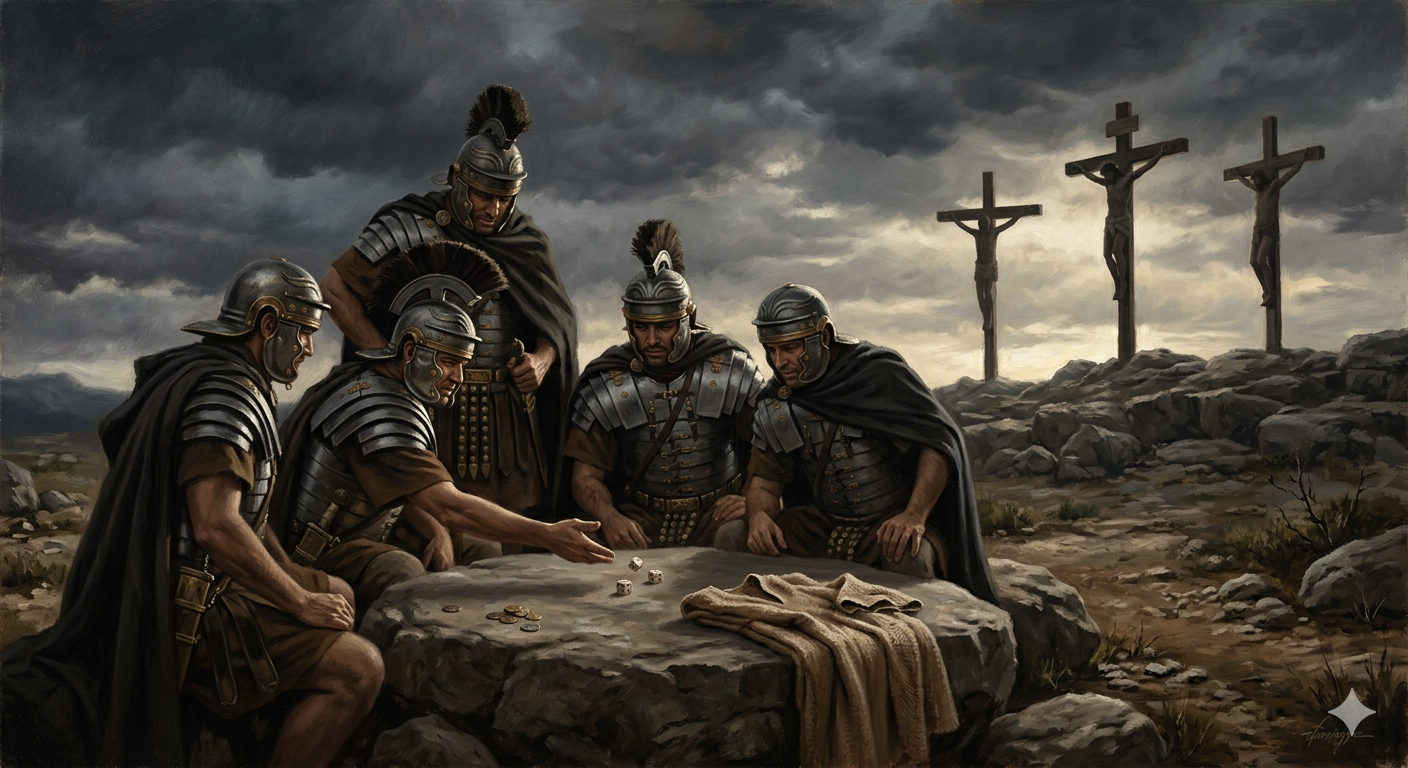
Verse 18 they divide my garments among them, and for my clothing they cast lots.
- What was the author’s situation? I can’t imagine this happening to David. It must have been purely prophesy about Jesus.
- How does this look forward to Jesus? As Jesus hung on the cross, the soldiers divided His clothes among them. They decided to gamble for the robe.
- How does this speak to my life today? Jesus, the divine Creator of the world, was reduced to a naked victim whose clothes were stolen by the men who had hung Him on the cross. He did that for me. If He was willing to do this for love, can I do any less?
Verse 19-20 But you, O LORD, do not be far off! O you my help, come quickly to my aid! Deliver my soul from the sword, my precious life from the power of the dog!
- What was the author’s situation? He is in danger for his life, so he cries out for God to quickly save him from his enemy.
- How does this look forward to Jesus? In Gethsemane, Jesus begged the Father to find another way. On the cross, He felt that His Father was far away. He did not use His divine power to deliver Himself, but He depended solely upon the Father for deliverance or not. His enemies were unworthy while His life was extremely precious.
- How does this speak to my life today? In danger, my only hope of deliverance is God, so I must look to Him for salvation. However, I must be ready as the Hebrews who refused to worship the golden idol were to say that even if God does not deliver me, I will still only worship Him. I must appeal to God, but then leave whether I die or live in His hands.
Verse 21 Save me from the mouth of the lion! You have rescued me from the horns of the wild oxen!
- What was the author’s situation? God answered His prayer for deliverance. He was saved from the power of the beast-like men who had been threatening him.
- How does this look forward to Jesus? Although Jesus died, He did not remain in death’s grip. The Father called Him forth from the grave. Satan had no power over Him.
- How does this speak to my life today? Even when it looks like there is no rescue, I can count on God to bring about the best result for me. He can break the power of Satan in my life. He will break the power of death over me.
Verse 22 I will tell of your name to my brothers; in the midst of the congregation I will praise you:
- What was the author’s situation? He wanted to tell everyone about how God had rescued him.
- How does this look forward to Jesus? Both before His death and after His resurrection, Jesus bore witness to the Father’s love and justice.
- How does this speak to my life today? God’s gracious loving kindness calls for my praise. I want to be a witness that He is worthy to everyone.
Verses 23-25 You who fear the LORD, praise him! All you offspring of Jacob, glorify him, and stand in awe of him, all you offspring of Israel! For he has not despised or abhorred the affliction of the afflicted, and he has not hidden his face from him, but has heard, when he cried to him. From you comes my praise in the great congregation; my vows I will perform before those who fear him.
- What was the author’s situation? David is telling of God’s worthiness to his brothers and the larger assembly. David says his praise for God is because He did not ignore David in his need. Instead, God had compassion and rescued David.
- How does this look forward to Jesus? Jesus said that if He were lifted up, He would draw all men to Himself. In drawing us to look at Him, He then points us to heaven to glorify the Father. Jesus is testifying that the Father is worthy. He loved mankind so much that He sent His Beloved to rescue them. The Father does not abhor us even when He abhors our actions. He heard our pain and responded.
- How does this speak to my life today? When I contemplate Jesus’ love for me on the cross and His promise of life with Him forever, I want to shout to others that God loves me. I stand in awe of His care for me and for humanity that He would abase Himself in order to lift me up to heaven. Jesus descended to the depths of pain and degradation because that was where I am so that He could lift me to the heights of heaven to be with Him.
Verses 26-27 The afflicted shall eat and be satisfied; those who seek him shall praise the LORD! May your hearts live forever! All the ends of the earth shall remember and turn to the LORD, and all the families of the nations shall worship before you.
- What was the author’s situation? David turns his attention from his immediate situation to his ultimate destiny. He sees a time when there will be no more pain or suffering and all will serve God.
- How does this look forward to Jesus? This reminds me of the verse that says “looking to Jesus, the founder and perfecter of our faith, who for the joy that was set before him endured the cross, despising the shame, and is seated at the right hand of the throne of God” (Hebrews 12:2). Jesus looked forward to a time when all the ends of the earth would turn to the Lord, and there would be no more rebellion.
- How does this speak to my life today? Even as I endure the pain of this life, I know that because of Jesus’ actions there will be a time of no death or sorrow. Now I have afflictions but the time will come when I and fellow believers can live in joy, and we will worship the One who loves us completely.
Verses 28-29 For kingship belongs to the LORD, and he rules over the nations. All the prosperous of the earth eat and worship; before him shall bow all who go down to the dust, even the one who could not keep himself alive.
- What was the author’s situation? David is acknowledging God’s rulership of the whole earth, not just Israel.
- How does this look forward to Jesus? Jesus is the King of kings and Lord of lords. The dead shall be resurrected and worship their Savior. We will all acknowledge His sovereignty.
- How does this speak to my life today? Jesus has promised us that we will have a big celebration banquet when we get to heaven—both those who are alive when He comes and those that He raises from the dead. “ For the Lord himself will descend from heaven with a cry of command, with the voice of an archangel, and with the sound of the trumpet of God. And the dead in Christ will rise first. Then we who are alive, who are left, will be caught up together with them in the clouds to meet the Lord in the air, and so we will always be with the Lord. Therefore encourage one another with these words” (1 Thessalonians 4:16-18).
Verses 30-31 Posterity shall serve him; it shall be told of the Lord to the coming generation; they shall come and proclaim his righteousness to a people yet unborn, that he has done it.
- What was the author’s situation? David is still looking to the future. He does not glory in his own crown; instead, he acknowledges the rulership of the King of heaven. He views God’s actions from a generational perspective while David is simply the king of one generation.
- How does this look forward to Jesus? This was the reward that Jesus went to the cross for—the elimination of sin from the universe. We will proclaim to those not yet in existence the love that God had for us poor sinners. We will tell of what Jesus has done forever.
- How does this speak to my life today? I must speak of the Savior who loves me. There are many who do not know about Jesus’ love and sacrifice. I must proclaim this great Truth of God to those who do not know.