This is an essay that focuses on three widely different topics that are all related. That is what good Bible study teaches you. The stories in the Bible are written in layers, and as you plumb the depths of an old story, more and more meaning will open up to you. If your Bible study does not provide you with this kind of experience, maybe my re-examination of the story of Hagar will spark your imagination so that you begin to look at old stories in a new light. In other words, one focus of my examination of this old story is to teach you how to improve your Bible study experience. A second lesson from the story is that we need to get rid of our slave mentality. We often focus on Sarah and Abraham’s relationship in this story, but when we look at the story through Hagar’s perspective, we see that God was bringing her from a slave mentality to the faith of a child of God. The third message the story teaches is that we need to trust God’s character even when all the humans in the situation are messing each other up. We may treat each other badly, but we can be sure that God is there attempting to bring us all out of our selfish immaturity into a full knowledge of love.
Lesson 1—How to Study the Bible: People keep telling you to read your Bible and you try, but you just do not get much out of it. This may be because you have not learned some basic principles of reading. I teach reading, so that is one skill that I want to teach you today. You see, when you read the Bible, some of you are doing what reading teachers call “word calling”. You can read each word beautifully, but when you are finished, you do not have a clue about what you are reading. That is because you are not interacting with the text. You are not digging into the passage that you are reading to understand what it really says. I am going to show you some ways to do that.
Lesson 2—Get Rid of Your Slave Mentality: I am from the United States, and I have noticed that we Americans tend to arrogantly assume that we are the princes and princesses of the world. We believe that we are number one. We are powerful. We are the best, and no one better try to get in our way. Unfortunately, that kind of thinking is slave mentality. In systems with slavery, the only way to survive is to get as high up on the ladder as you can and to lord it over anyone who is under you. Never let anyone from below pull you down and keep pleasing the ones who are above you until you can get above them. Truly, it is not just Americans that think in this way. It is the whole world, but that is NOT the mentality of the kingdom of heaven. In the kingdom of heaven, true freedom comes from being a servant to others. Power is the result of treating even those who want to pull you down with kindness.
The final most important lesson from Hagar’s story: Trust God’s Character. Even when God is asking you to do something you do not like, trust God that He has a beautiful plan for your life, and He is only asking you to do what is necessary. Trust God that His method will work a lot better than the plans that you have when He calls you to do something new and different. Trust that the God that you see in the Old Testament is the same God you see being born as a baby in a manger, the same God you see dying on the cross for your sins. Trust God to always be God.
Okay, let’s get into the story. I used to read about Hagar and Sarah and Abraham and have a lot more sympathy for Hagar than the people who were supposed to be my role models. I would read what Paul said about Hagar, and I made a lot of assumptions that are not actually in the Bible. Here is one of those rules about studying the Bible. Do not assume. Look deeper. Let’s read one of the verses that troubled me in Galatians 4 verses 30-31.
“But what does the Scripture say? “Cast out the slave woman and her son, for the son of the slave woman shall not inherit with the son of the free woman.” So, brothers, we are not children of the slave but of the free woman”
My old way of thinking was “Poor Hagar. Life was against her. She was a slave, so Paul is blaming her for something she had no control over, and by today’s standards, she had basically undergone a power rape that resulted in a pregnancy that got her abused by her mistress, who was the one who put her into that situation to start with and ultimately, her mistress’ jealousy got her kicked out into the desert to die.” However, that is not what Paul said. When you get a chance, look closer at Paul’s lesson. He is not condemning Hagar. He is speaking of being born into slavery versus living in freedom.
Anyway, Sarah does not come out looking too good in my old scenario, but let’s use our reading skills to look more deeply. The first reading skill I want to remind you of is to consider the genre that you are reading. Genre is a fancy word that just means to think about the kind of information that you are reading. This is a biography not fiction. That means that it is about real people, not cartoon characters. Real people are mixtures of selfishness and godliness, at least those who choose to follow God. Real people live in a culture and a specific time and think according to the background they live in. Real people love and fear and hate and show friendship and have needs. When you are reading a biography from the Bible try to picture what is happening. Get into the minds of the people. Do not assume that they think the same way modern people do. Look at their motivations through their own society’s ideas.
Okay, we’re ready. Let’s practice our reading skills. We’ll start by reading Genesis 16:1-16.
Now Sarai, Abram’s wife, had borne him no children. She had a female Egyptian servant whose name was Hagar. And Sarai said to Abram, “Behold now, the LORD has prevented me from bearing children. Go in to my servant; it may be that I shall obtain children by her.” And Abram listened to the voice of Sarai. So, after Abram had lived ten years in the land of Canaan, Sarai, Abram’s wife, took Hagar the Egyptian, her servant, and gave her to Abram her husband as a wife. And he went in to Hagar, and she conceived. And when she saw that she had conceived, she looked with contempt on her mistress. And Sarai said to Abram, “May the wrong done to me be on you! I gave my servant to your embrace, and when she saw that she had conceived, she looked on me with contempt. May the LORD judge between you and me!” But Abram said to Sarai, “Behold, your servant is in your power; do to her as you please.” Then Sarai dealt harshly with her, and she fled from her.
The angel of the LORD found her by a spring of water in the wilderness, the spring on the way to Shur. And he said, “Hagar, servant of Sarai, where have you come from and where are you going?” She said, “I am fleeing from my mistress Sarai.” The angel of the LORD said to her, “Return to your mistress and submit to her.” The angel of the LORD also said to her, “I will surely multiply your offspring so that they cannot be numbered for multitude.” And the angel of the LORD said to her, “Behold, you are pregnant and shall bear a son. You shall call his name Ishmael, because the LORD has listened to your affliction. He shall be a wild donkey of a man, his hand against everyone and everyone’s hand against him, and he shall dwell over against all his kinsmen.” So she called the name of the LORD who spoke to her, “You are a God of seeing,” for she said, “Truly here I have seen him who looks after me.” Therefore the well was called Beer-lahai-roi; it lies between Kadesh and Bered. And Hagar bore Abram a son, and Abram called the name of his son, whom Hagar bore, Ishmael. Abram was eighty-six years old when Hagar bore Ishmael to Abram.
I was always troubled by God’s treatment of Hagar in this passage, but one day while I was studying Galatians, I gained some insight into the journey of God and Hagar. God was teaching Hagar how NOT to be a slave. His apparent harshness was to bring her to an understanding of her worth in His eyes, not because He thought that she was second-class to Sarah.
In the first part of Genesis 16, we get a picture of Hagar as a typical slave of her time. She was obedient to both Abram and Sarai. Some people would look at what happened to Hagar as rape, but we must not look at this ancient culture through modern eyes. This is a basic principle to use when reading the Bible. Understand the times that you are reading about as much as possible. If we look at the times Hagar lived in and judge by her later actions in the story, I believe that Hagar actually approved of the idea of sleeping with her mistress’s husband. Remember, Hagar was the slave of a powerful woman, Sarah, who was second only to Abraham in the camp. This was not a small group of shepherds. One place I read estimated that Abraham had about 2,000 people under him. As Abraham’s wife, Sarah was in power over all those people. As the slave of a powerful woman, Hagar had had more power than most of the other people in the camp.
(Now, just a little side note here. When we are speaking about slavery in the Old Testament, we are not speaking about the same kind of evil that took place in the United States. We are talking about a different type of sinful system. We are speaking about a way of life where everyone was under someone. This was not a society of equals. There was always someone around who could tell you what to do, and there were others that you could order around. We still have some cultures like this today. I lived in Saudi Arabia for a short time and that gave me a lot of insight into this kind of thinking. Essentially, everyone is a slave to someone higher up in the system. The king has the power to order his cousins’ death, even though they are royalty. Princes have the power to order around everyone, except the king. The friends of princes have the power to order most people around because of their relationship to a prince, but they make sure to keep pleasing the prince so that they can keep their power. That is the kind of society we’re talking about. The second principle that I want to point out is that you should not assume that God approves of something like slavery just because His people in the Bible participate in it. The Bible is full of examples of God meeting us where we are in our own cultures and working with us to bring us to the culture of heaven.)
Anyway, let’s get back to Hagar becoming Abraham’s second wife. For Hagar, this was a step up the ladder of power. This was a way to one-up her mistress. Beautiful Sarai who even in her older years could tempt the most powerful man around–the Pharaoh—would have to share her own husband with Hagar. Powerful Sarai, who was honored above all other women in the camp and second only to Abram, would have to share her husband with Hagar. In sleeping with Abram, Hagar would obtain power and a heritage beyond her wildest dreams. Sarai might have the upper hand now, but Hagar would achieve more power than Sarai through bearing Abram’s heir. Hagar would succeed where beautiful, powerful Sarai had failed. Frankly, I think Hagar was eager to share Abram’s bed because she had a slave mentality which said that the more power you had, the more freedom you had. This mentality says that when you become the superior, others will be your slaves.
Hagar slept with Abram and achieved her wildest dreams. She became pregnant. It is likely that she started immediately being treated like a princess by those around her. Other slaves deferred to her even more than before, but it was not just the slaves. All the other men and women who lived with them would have started treating her differently. She was special. She was going to have the son of the most powerful man in camp. It went to her head like sudden fame usually does. She began thinking of herself as a powerful, free woman. However, the problem was that she still had the mentality of a slave. Thus, when Sarah ordered Hagar to do something, it seemed that Sarah did not understand the new reality. Sarah was not respecting that she, Hagar, was carrying the master’s heir in her womb. What would someone who thinks like a slave do? She started fighting to keep her new dominant position. I am sure that Hagar started backtalking Sarah and probably even refused to obey. For Sarah, the problem was not just a personal spat between two wives. Hagar’s rebellion would have had repercussions that spread throughout the whole camp. In a society where your relationship to a more powerful person determined what your position would be, you changed loyalties when the power changed. Hagar’s rebellion would have sparked rebellion in other people. Other servants would have started to treat Sarai differently also. They would have started showing more respect to Hagar than to Sarai because of Hagar’s attitude. Servants knew which way the winds blew and knew how to put on a front before someone who would soon have more power over them than the free woman. Throughout the camp, everything was changing, and not for the good as far as Sarai’s treatment was concerned. It was understandable that Sarai was upset.
I used to blame Sarai for being a hypocrite because she was complaining about the very situation that she had created and blaming it on her husband. However, this situation was not just about jealousy over a slave woman sleeping with her husband, or about the slave woman becoming pregnant when Sarai could not. This was about the way Hagar was using the situation to try to steal Sarai’s position as the head of the household after Abram. There were a lot of life-threatening implications for Sarai because of Hagar’s response to becoming the mother of the heir of the household.
I also used to blame Abram for his treatment of Hagar and for avoiding dealing with the problem by pushing it back onto Sarai, but now I see that in reality, he was acting in wisdom. If he had reprimanded Hagar himself, the problem would have persisted, except it would have gone underground. It would have just seemed like a domestic dispute. The camp would have interpreted the situation as Abraham simply informing the camp that he wanted both of his wives to respect each other, but the message would have still been that Hagar was superior to Sarai because of the heir. On the other hand, by confirming to Sarai that Hagar was still her slave, Abraham was also confirming Sarai’s position as the head of the household after him to the whole camp.
This also explains Sarai’s harsh treatment of Hagar. If Hagar’s attitude had infected the whole camp, it would have been necessary to publicly humiliate Hagar and put her in her place. Most likely, Hagar did not accept Sarai’s discipline at first. Hagar would have pushed back thinking that force was the way to maintain her position because she was still thinking like a slave. She had grabbed a certain amount of power and believed that she needed to maintain every shred of influence that she had won at all costs. She knew that other people would treat her according to the power that she was able to wrestle from the situation. She probably kept fighting against Sarai, which would have caused Sarai to push back while Abraham stayed out of the situation so that Sarai’s power would be confirmed. In the end, Hagar pushed so hard and Sarai pushed back with such force that Hagar believed that her position had become impossible. Hagar had burned her bridges with her mistress, and if her mistress continued to treat her as she had been doing, life would not be worth living. Hagar was worse off now than when she had been her mistress’ honored slave. Hagar had played for high stakes, but she had lost, and she could see no hope for her own future. In Hagar’s slave mentality, she could see no way out. She decided that her only hope was to run away.
Now, before we get to that. We need to go back and consider Hagar’s relationship to God. Like all of Abram’s household, Hagar would have participated in the worship of Yahweh. She may have secretly longed for her old gods of Egypt, but as a servant, it was in her best interests to follow her master’s God. Also, she would have seen that Yahweh gave Abram special protection and prosperity. She would have been attracted to the benefits that came from the worship of Yahweh. She knew that Yahweh was real and that he took special care of Abram’s household. On the other hand, she did not trust Yahweh to honor a slave like her. That was why she did not look to Yahweh for help or strength in the crazy situation that she had helped to create. As a result, she fled into the desert to escape the mess that her life had become. The only problem was that there was not much hope for a pregnant lone woman to survive in that wilderness. Hagar would have known that, so we have some indication of how bad the situation had become between her and Sarai. Hagar was feeling hopeless and helpless. Then an angel from Yahweh confronted her at the well and gave her promises of God’s blessing. This meant more than just a promise that her son would take care of her in the future. It meant that she had standing in the eyes of Yahweh even though she was a slave. It meant that God valued her and would extend the same protection to Hagar the slave that he had given to Abram.
I used to think that God was favoring Sarai when he sent Hagar back to slavery as if God was taking sides, but no, something wonderful for Hagar was happening. The truth was that this was Hagar’s first step to freedom—knowing that God saw her as an individual and gave her promises. The angel tells her the LORD has listened to your affliction and Hagar understood that this encounter meant that she, not Sarai or Abram, but Hagar was special to God. The Bible says she called the name of the LORD who spoke to her, “You are a God of seeing,” for she said, “Truly here I have seen him who looks after me.”
For a long time, Hagar had tried to please her mistress to gain security and power. Then she had looked to pleasing her master Abraham for security. Then she had attempted to grab power for security. But finally, finally, finally her gaze turned to the right source for protection. This was the first step towards freedom. What are you focusing on to gain security? A person, money, power, your work, the government, your family? Stop thinking like a slave. The first step to freedom is to depend on God for your security.
However, Hagar still had a lot to learn before she could be truly free. God was trying to teach her how to live in freedom even though physically she was still a slave just as He is trying to teach us to live in freedom now here on earth even though we are living in a world that is still operating on the principles of slavery to sin. God sent Hagar back to the place where she had burned all her bridges and told her to rebuild her place there. The angel of the LORD said to her, “Return to your mistress and submit to her.” Hagar had to right the wrongs that she had done. She had to return and face all the others that she had lorded it over and also face her mistress that she had been competing with, and she had to SUBMIT. She had to humble herself before everyone.
But God did not send Hagar back into the situation to face it alone. God told her to stop grabbing for power, but He also gave her the tools that she needed to survive without grasping for power. He became her protector. She now had security that even the most powerful person in her life, Abraham, could never give her. She had the approval of Abraham’s Master. God had shown everyone in the camp that he valued Hagar in a special way. She would no longer need to push others down in order to be lifted up. God Himself had lifted her up. He had promised that she would be a mother of many descendants. The angel of the LORD also said to her, “I will surely multiply your offspring so that they cannot be numbered for multitude.” When Hagar returned, she came back with God’s blessing on her. For this reason, she could stand with honor before the whole camp while still respectfully submitting to her mistress. She and Sarai would never become friends or sisters, but they could live together in the camp without splitting it apart with their power struggles. But more importantly, Hagar was learning to think as a free person who did not have to grasp for power in order to survive. She was learning to trust God to take care of her.
Now we are going to fast forward in the story. Let’s look at Genesis 21:8-21
And the child grew and was weaned. And Abraham made a great feast on the day that Isaac was weaned. But Sarah saw the son of Hagar the Egyptian, whom she had borne to Abraham, laughing. So she said to Abraham, “Cast out this slave woman with her son, for the son of this slave woman shall not be heir with my son Isaac.” And the thing was very displeasing to Abraham on account of his son. But God said to Abraham, “Be not displeased because of the boy and because of your slave woman. Whatever Sarah says to you, do as she tells you, for through Isaac shall your offspring be named.
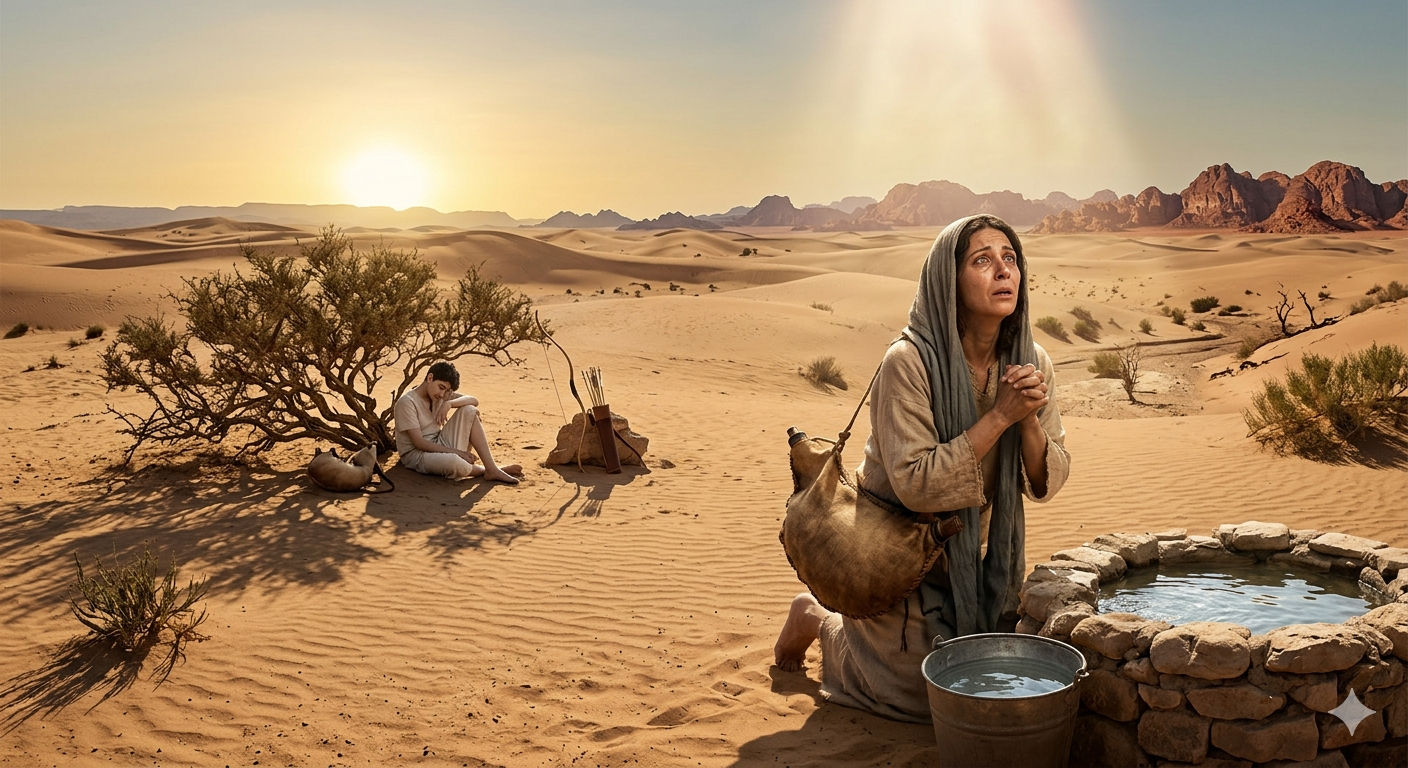
And I will make a nation of the son of the slave woman also, because he is your offspring.” So Abraham rose early in the morning and took bread and a skin of water and gave it to Hagar, putting it on her shoulder, along with the child, and sent her away. And she departed and wandered in the wilderness of Beersheba. When the water in the skin was gone, she put the child under one of the bushes. Then she went and sat down opposite him a good way off, about the distance of a bowshot, for she said, “Let me not look on the death of the child.” And as she sat opposite him, she lifted up her voice and wept. And God heard the voice of the boy, and the angel of God called to Hagar from heaven and said to her, “What troubles you, Hagar? Fear not, for God has heard the voice of the boy where he is. Up! Lift up the boy, and hold him fast with your hand, for I will make him into a great nation.” Then God opened her eyes, and she saw a well of water. And she went and filled the skin with water and gave the boy a drink. And God was with the boy, and he grew up. He lived in the wilderness and became an expert with the bow. He lived in the wilderness of Paran, and his mother took a wife for him from the land of Egypt.
There are parts of this passage that puzzled me for a while, so I had to look deeper. First of all, this whole idea of a child confused me. Hagar had lived in submission to Sarah for more than fourteen years because the Bible says that Ishmael was 13 years old when he was circumcised. “And Ishmael his son was thirteen years old when he was circumcised in the flesh of his foreskin” (Genesis 17:25). I am not sure how much later it was when Isaac was born, but the next part of the story comes when Isaac was 2 or 3, so Ishmael had to be at least fifteen and maybe even in his twenties. However, things cleared up when I dug a little deeper. Strong’s dictionary says that the Hebrew word is /ye-led/ which can also be young man. Other Bible translations indicate that the child was not put on her shoulder. The meaning seems to be that Ishmael was sent with her. You can use the same Bible study strategies I used when you do not understand some detail in a Bible story. Put the facts together that you know from the passages. Compare Bible verse to Bible verse. Look in concordances and Bible dictionaries. Discuss your ideas with others. Find answers to your questions!
Let’s use some reading strategies to get some insight into what is happening in this passage. Who is the main character in this story? I think it is interesting that Hagar is still the main character here, not Ishmael. Abraham sends his son in Hagar’s care. We are not told what Abraham said to his son, only about his interactions with Hagar. Reading between the lines, we can understand that Hagar was receiving respect from Abraham. Hagar had earned her place in the camp. Hagar was under God’s protection still.
Now, let’s look at what we can figure out about Ishmael’s personality. Ishmael was probably both spoiled because of his position and at the same time insecure because his place as heir was not confirmed. Have you ever seen people who are in a high role, but they feel insecure about their position? You might have had a boss like that? They can be difficult to work or live with. These insecure people try to maintain their status by pushing down anyone who threatens them. They lord it over people and value outward signs of their importance. In short, they have a slave mentality. They are not free to live in humility because of their own insecurities. In other words, Ishmael was free physically, but because of the way that he had grown up, he thought like a slave.
Ishmael had grown up for at least thirteen years in this situation. Then against all possibility, Sarah had a son. Suddenly, Ishmael was confronted with a reality that he refused to accept. This baby was not his little brother; this baby was a thief coming to steal Ishmael’s position from him. Sarah saw the danger to her baby in the eyes of Ishmael when he looked at his little brother and mocked the little boy. Hagar may have submitted to Sarah, but Ishmael had not. Now, Sarah saw her only son’s death in the eyes of Ishmael’s mocking face, and she moved to protect him.
And that’s how we come to the morning where Abraham was sending his oldest son away forever. Hagar knew Abraham, and she knew that if Yahweh had ordered their exile, Abraham would not go against Him, so she knew her fate. Maybe, she had known her fate for years. Ishmael, on the other hand, was a different kettle of fish.
I am confident of the details that I have given you so far based on the Bible and human nature and my knowledge of cultures, but this next part is my own reconstruction of what happened. It may have gone down differently, so do not take this as gospel, but remember a good technique of Bible study is to try to picture what you are reading. I can picture Ishmael as a spoiled young man feeling betrayed as he realized that his father was sending him away. I can see him stubbornly refusing to carry the food and water that Abraham was trying to give him so that Abraham had to put it on Ishmael’s mother’s back to carry. Remember, the angel had said that Ishmael would be “a wild donkey of a man, his hand against everyone and everyone’s hand against him.” That is why I can imagine that Ishmael had a big chip on his shoulder.
Ishmael was the spoiled son of a rich loving father, who was now sending him away. Not only was his place as the young prince gone, but the father he counted on for love and caring was rejecting him. I can picture Ishmael running off without thought or planning, and Hagar following behind trying to calm him down. I can see him expending his energy in anger and frustration and stubbornness. I always wondered why Abraham did not supply the two exiles better, but I now believe that he did give them enough food to get to the next oasis. I think he was sure that he had supplied them with sufficient food and water. It is likely that Ishmael was the variable that Abraham had never considered. I doubt that Ishmael quietly strolled along to the next oasis with his mother. It is more probable that Ishmael ran off and got them lost in his emotional tantrum.
As I said, I may be wrong, but this is the only way that I can see an older woman having more ability to survive in the desert than a healthy young man. Ishmael may have been pampered and out of shape compared to his mother, but he should have been able to last as long as her in the desert. However, if he had ignored the heat in his emotional outburst and gotten heat stroke and not conserved his energy while she in her greater experience had carefully maintained her physical resources, it would make sense. When he finally calmed down, they were lost. They wandered around trying to find the oasis, but they did not succeed, and the water was gone. When Ishmael finally collapsed, Hagar hauled Ishmael under a bush, but she could not bear to see all of her hopes and the only person she loved die, so she dragged herself to another bush far away and sat there in despair. From that distant bit of shade, she could not hear her son’s cries, but nevertheless, he was crying. Was Ishmael finally crying to Yahweh and asking Him, “Why? Why is this happening? Why did You tell my father to get rid of me? WHY?”
The Bible says that Ishmael cried to Yahweh, but when Yahweh answered, He did not speak directly with Ishmael. He spoke with Ishmael’s mother. God was again confirming her importance, not just to herself, but also to her son. Probably, all his life, Ishmael had seen Abraham and Sarah as the important members of the camp while his mother was secondary. He saw power in others but not his own mother. Now, God was showing Ishmael that Hagar was important. God spoke to Hagar, not Ishmael, confirming her position with God as her protector.
Back to the question that Ishmael may have cried out to God—Why? I think a key verse for why this whole situation had happened is at the end of this passage: And God was with the boy. In his pain and shame and anger, Ishmael was finally ready to meet God. This was no longer the God of his father or even the God of his mother. Now, Ishmael called on God and when he finally spoke directly to God, God responded and stayed with him. The stubborn donkey of a man learned a lesson. He almost got his mother killed because of his self-focus. He felt rejected by his earthly father, but in the desert under a bush, he found his true Father. He learned to respect his mother and to serve his God. Through this trial, God set both Hagar and Ishmael free. It was Hagar, not Abraham, who found a wife for her son. It was Ishmael who became known for his ability and skill and who founded his own nations. He was raised a leader, but he had to get out from under the shadow of Isaac before he could become a real leader, and not just a fake stand-in for the true child of promise.
These are the generations of Ishmael, Abraham’s son, whom Hagar the Egyptian, Sarah’s servant, bore to Abraham. These are the names of the sons of Ishmael, named in the order of their birth: Nebaioth, the firstborn of Ishmael; and Kedar, Adbeel, Mibsam, Mishma, Dumah, Massa, Hadad, Tema, Jetur, Naphish, and Kedemah. These are the sons of Ishmael and these are their names, by their villages and by their encampments, twelve princes according to their tribes. (These are the years of the life of Ishmael: 137 years. He breathed his last and died, and was gathered to his people.) They settled from Havilah to Shur, which is opposite Egypt in the direction of Assyria. He settled over against all his kinsmen. (Genesis 25:12-18)
Hagar went from slave to free woman to the mother of princes. Her grandsons were not just regular men. They are called the twelve princes. Each of these princes created his own tribe. We are not told how long Hagar lived. Ishmael lived to be 137 years old, so she might have lived to a very old age as a daughter of God respected by those around her, not just because she was the servant of a powerful woman, not just because she had a son by powerful Abraham, but because she, Hagar, was favored by Yahweh Himself and had spoken to His angels, not once, but twice, and maybe more. In fact, God spoke to her like He spoke to Abraham. Think of it, in the Bible we are not told of any others who were spoken to in this way during this time period. Hagar was obedient to God, and He took care of her. She learned to stop thinking in terms of power and slavery and to start thinking in terms of serving Yahweh, and as a result, she prospered. She went through struggles and despaired, but she learned to have a relationship with God and that freed her and made her the founder of a dynasty of princes.
Now, let’s get back to the three lessons that I wanted you to remember today. First, how to study your Bible: Do not just call out words. Instead, try to picture what is happening in the story. Never judge an ancient situation based on modern culture. Attempt to understand the people within their own times. Most of all, do not judge God by the actions of the humans in the story. Look directly at God as He is revealed throughout the Bible, and ask yourself how the story makes sense if God is acting in love.
Second, Get Rid of Your own Slave Mentality. Stop trying to grab security for yourself. Instead, live by the rules of freedom. What are those rules? They all come down to the last lesson.
Trust God’s Character. God is love. When He sent Hagar back to submit, He was moving to bring about the best outcome for Hagar. When He sent Ishmael and Hagar away, He was not choosing Isaac and rejecting Ishmael. He was sending Ishmael off to freedom so that he would not have to live a half-life in Isaac’s shadow. God was saving Ishmael from fratricide. God was choosing what was best for all the people involved in the situation. When God brings you to a place where you need to humble yourself and let go of some goal or ambition, remember, it is so that you can be free. When God sends you away from your place of happiness and security, He is sending you towards a great destiny. God is looking out for You. He sees You. Just as Hagar was important in God’s eyes, so are you. Trust Him to be true to His promises to You. Trust God to always be God.