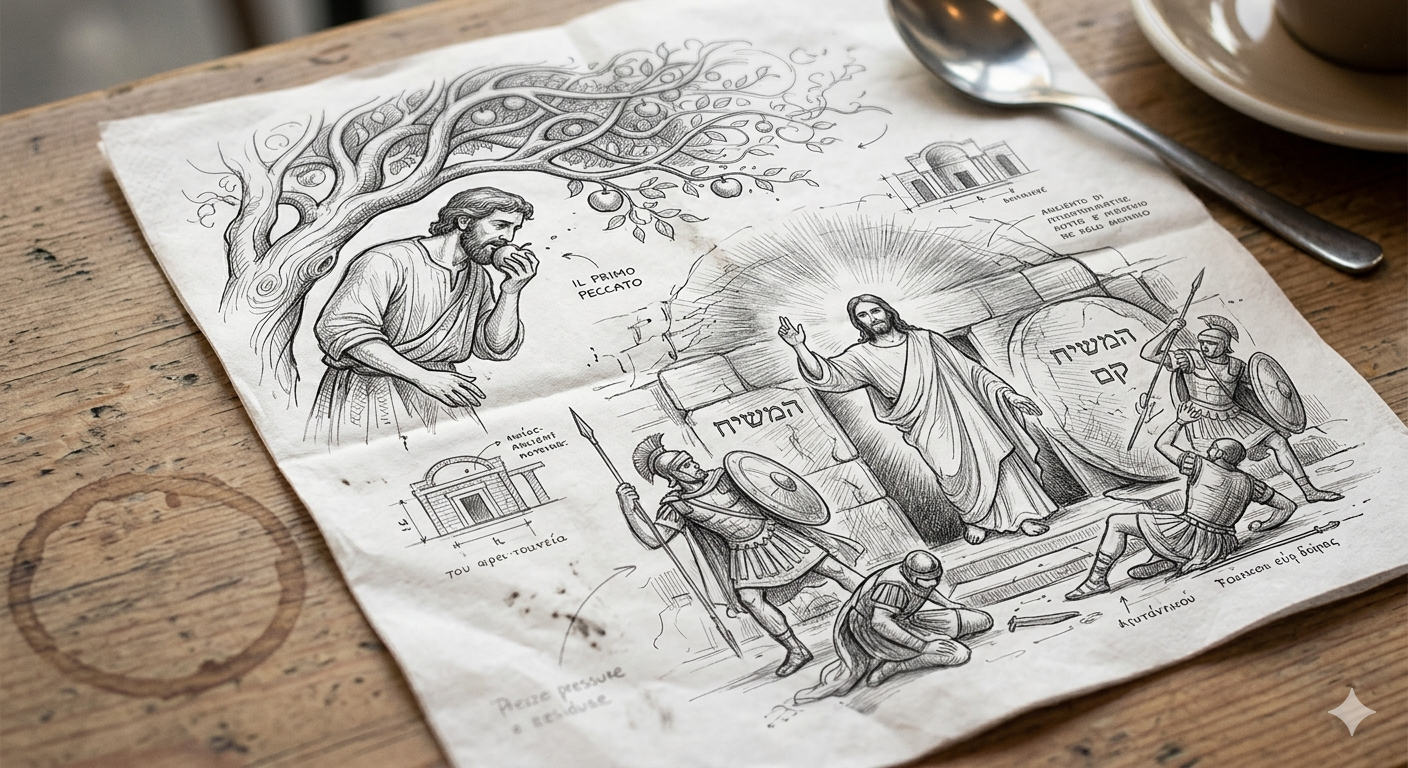
Paul speaks of Adam as a type of Jesus. In another place, he tells his readers that the failures of the children of Israel in the desert are an example for us. In Hebrews, we are told that the earthly sanctuary and its ceremonies are copies of the true heavenly temple. Type, example, and pattern may seem like different ideas, but in the original Greek, they are all the same word. Theologians use the English word typology to refer to the Bible’s use of symbols as described by this Greek word. Actually, the New Testament uses two related words when speaking about symbols. The first word is /typos/ or /tupos/ which gives us the English word type. This is the symbol or copy of something. The second word is /antitypos/ which we call the antitype in English. The antitype is the original or the true thing that the type has copied. A formal definition of typology is that it is a specific interpretation of persons, events, or institutions that prefigure Jesus or other realities contained in the gospel. Remember, types are not limited to pointing to Jesus as our Messiah (although many do). They can also point to a future event or a person or to a greater reality.
One important detail to remember is that the antitype can come before or after the type in time. In other words, the true thing can exist before a copy is made of it (like the heavenly sanctuary that Moses’ sanctuary copied), or a true thing can be made into a symbol for a later truer thing (like Adam being a type and Jesus being the antitype).
You do not need to have a degree in theology to delve into the typology of the Bible. You just need to study God’s word for yourself. In this lesson, we will examine some specific passages in the New Testament that use the two Greek words that signal the use of symbols.
The first verse is Romans 5:14 “Yet death reigned from Adam to Moses, even over those whose sinning was not like the transgression of Adam, who was a type of the one who was to come.”
- Who was the type (or symbol) in Romans 5:14? Adam
- Who was the antitype (or the true form)? Jesus
Now let’s read the fuller context to understand the relationship between the type and antitype.
Romans 5:12-19
(12) Therefore, just as sin came into the world through one man, and death through sin, and so death spread to all men because all sinned—(13) for sin indeed was in the world before the law was given, but sin is not counted where there is no law. (14) Yet death reigned from Adam to Moses, even over those whose sinning was not like the transgression of Adam, who was a type of the one who was to come. (15) But the free gift is not like the trespass. For if many died through one man’s trespass, much more have the grace of God and the free gift by the grace of that one man Jesus Christ abounded for many. (16) And the free gift is not like the result of that one man’s sin. For the judgment following one trespass brought condemnation, but the free gift following many trespasses brought justification. (17) For if, because of one man’s trespass, death reigned through that one man, much more will those who receive the abundance of grace and the free gift of righteousness reign in life through the one man Jesus Christ. (18) Therefore, as one trespass led to condemnation for all men, so one act of righteousness leads to justification and life for all men. (19) For as by the one man’s disobedience the many were made sinners, so by the one man’s obedience the many will be made righteous.
- What happened through Adam? Sin became part of humanity. In other words, humans became sinners. Death entered the world and all men and women are under condemnation.
- What happened through Jesus? Jesus brought humanity the gift of grace. We were able to receive justification. As a result, life replaced death for all men. Jesus brought us the free gift of righteousness so that many men will be made righteous.
- Verse 19: How does Paul say that Jesus and Adam are related? Their actions affected the whole human race. Adam’s disobedience and Jesus’ obedience changed everything about humanity.
- Verse 16: How are the results of Adam’s actions different from the actions of Jesus? Death resulted from only one sin, but Jesus’ actions resulted in life despite many sins.
- Why did Adam’s sin result in all humans being sinners? All humans are descended from Adam, the sinner. He was the father of all humans.
- How is Jesus like Adam? He is the human father of all humans who will have eternal life.
Jesus is an example of a situation where the antitype existed before the type. However, Jesus did not fully become an antitype of Adam until His incarnation. At that point, He became the true human Father of the human race, as well as its Creator. It is important not to limit the antitype by the type. The type is a restricted symbol that does not contain all aspects of the antitype. If we look at Colossians 1:15-20, we see that Jesus is so much more than simply the fulfillment of Adam’s type.
Verse 2: Colossians 1:15-20
(15) He is the image of the invisible God, the firstborn of all creation. (16) For by him all things were created, in heaven and on earth, visible and invisible, whether thrones or dominions or rulers or authorities—all things were created through him and for him. (17) And he is before all things, and in him all things hold together. (18) And he is the head of the body, the church. He is the beginning, the firstborn from the dead, that in everything he might be preeminent. (19) For in him all the fullness of God was pleased to dwell, (20) and through him to reconcile to himself all things, whether on earth or in heaven, making peace by the blood of his cross.
- What do these verses tell you about Jesus?
- We can see the Father when we look at Jesus. We cannot see God, but we can see Jesus and through Him we know what the Father is like.He is the firstborn of all creation. It is important to know what Paul means by firstborn. This is not saying that Jesus was originally created. Look at verse 18. Paul explains one of the things that he means by firstborn there. Jesus is the firstborn from the dead. As a human, Jesus was the firstborn, not as God. In the Bible, the firstborn was the preeminent (most important) of the children. As a human, Jesus is the leader of us all. Basically Paul is saying the same thing here as he did in Romans. He is saying that Jesus is the leader and head of the human race.
- Jesus is the Creator of everything. As God, Jesus is preeminent because He is our Creator. He existed before everything else did. He holds everything together. Thus, He is the leader and head of the human race as our Creator.
- Jesus is the head of the church. He is preeminent as the leader of all who believe. We look to Jesus for instruction in what to do and how to act. He tells us what to do, and we obey because He is our leader.
- “The fullness of God was pleased to dwell” emphasizes that Jesus is both God and human. This is why His life and death brought peace between God and man.
Through Adam (the type) death entered the world. Through Jesus (the antitype) life overcame death. The antitype is greater and bigger and more significant than the type. When we see a type in the Bible, we need to be aware that it is a limited symbol of something much more significant, so we should not restrict the antitype to the boundaries imposed by the type in our thinking. The type points to the antitype in some way, but it is not equal to the antitype.
Throughout history, many Christians have become confused by types and symbols in the Bible because they have attempted to force their own interpretations of the symbols based upon their culture or set viewpoints. When studying the typology of the Bible, it is important to look for understanding in the scriptures themselves and not rely on our own pet theories or interpretations that come from secular or even idolatrous sources. The types in the Bible are always explained more clearly in later scriptures. In fact, there is a pattern in the way that types and antitypes are used in the Bible. “It is crucial to understand that the writers of the New Testament did not randomly attribute a typological meaning to some Old Testament texts in order to make a point. An Old Testament type is always validated in the prophetic writings before it acquires an antitypical fulfillment in the New Testament.” (Taken from Lessons of Faith from Joshua: Adult Bible Study Guide by Barna Magyarosi). In other words, you will find various indicators of a type’s ultimate fulfillment in the Old Testament before you see the explanation in the New Testament. A lot of people seem to think that the writers of the New Testament, including Paul, came up with their theology out of thin air–that it was original to them. However, if we read the writings of the authors of the New Testament carefully, we see that their lessons and examples all have roots in the Old Testament, i.e. the antitypes were first pointed to by Old Testament types.
Let’s look at another type/antitype example from the New Testament.
Verse 3: 1 Corinthians 10:1-13
(1) For I do not want you to be unaware, brothers, that our fathers were all under the cloud, and all passed through the sea, (2) and all were baptized into Moses in the cloud and in the sea, (3) and all ate the same spiritual food, (4) and all drank the same spiritual drink. For they drank from the spiritual Rock that followed them, and the Rock was Christ. (5) Nevertheless, with most of them God was not pleased, for they were overthrown in the wilderness. (6) Now these things took place as examples for us, that we might not desire evil as they did. (7) Do not be idolaters as some of them were; as it is written, “The people sat down to eat and drink and rose up to play.” (8) We must not indulge in sexual immorality as some of them did, and twenty-three thousand fell in a single day. (9) We must not put Christ to the test, as some of them did and were destroyed by serpents, (10) nor grumble, as some of them did and were destroyed by the Destroyer. (11) Now these things happened to them as an example, but they were written down for our instruction, on whom the end of the ages has come. (12) Therefore let anyone who thinks that he stands take heed lest he fall. (13) No temptation has overtaken you that is not common to man. God is faithful, and he will not let you be tempted beyond your ability, but with the temptation he will also provide the way of escape, that you may be able to endure it.
- Look in verses six and eleven. There is one word that in the original Greek is /typos, tupos/, in other words, the type. What word do you think that is? The word is “example(s).” Try reading those verses again, but this time say “type” instead of “example.”
- According to this passage, what was the type (in general)? The actions of the children of Israel leaving Egypt and heading towards the Promised Land.
- What is the antitype? Our lives today. For us, the things that happened before are not our reality. Our own lives are more preeminent to us than those of dead people.
- Why is this type important for our lives today (verse 11)? So we can learn from them. Some people focus only on the New Testament, but according to Paul, we need the examples/types in the Old Testament for our present lives. We learn from them.
- Do you know what events are being referred to in verses 1and 2 ? God being with His people as they crossed the Red Sea.
- According to verse two, what is the antitype for the parting of the Red Sea? Baptism. Of course, baptism in turn is a type pointing to the antitype of Jesus’ death and resurrection. The Bible is full of layers upon layers of meaning that need to be pulled back to see even greater meaning. It takes effort and concentration, but the rewards are worth it.
- Do you know what events are being referred to in verses three and four? The children of Israel ate manna in the desert. This food was provided by God. The drink was the water that miraculously poured from a rock through God’s power. The people were totally dependent upon God for their survival in the wilderness. He provided, and they accepted the gift, so they lived.
- According to verse four, what is the antitype to manna and the water from the rock? Jesus—He is the bread of life. He told the woman at the well that He could provide living water to drink so that she would never thirst again.
- Verses five, seven, nine, and ten are negative types of desiring evil. Do you know what events are being spoken of in verses five and seven and nine?
- 5 = The generation that refused to enter Canaan because of fear died in the wilderness and did not enter the Promised Land.
- 7 = Balaam could not curse Israel, so he gave the advice to Balak, the king of Moab to have the women seduce the men of Israel into idol worship. (Numbers 25:1-8)
- 9 = (Numbers 21:4-9) The people blamed God for their circumstances and longed for the corrupt world of slavery that they had left behind in Egypt, so God withdrew His protection, and they were bitten by poisonous snakes. God told Moses to make a bronze snake on a pole and if the people looked at it, they lived. Jesus later applied the serpent on the pole to Himself when He was speaking to Nicodemus.
- 10 = (Numbers 16) Korah rebelled against Moses and tried to become the priest of God when God had not put him in that position. This was presumption. Therefore, God destroyed him and his followers. The next day many people were grumbling against Moses and Aaron claiming that they had killed Korah rather than God. 14,700 people died of a plague sent by God because of their grumbling. Basically, they were rebelling against God. The plague only stopped because Moses and Aaron were interceding for the people.
These verses are types of rebellions that Christians can fall into and lose their claim to heaven. We need to study each of these types to understand the dangers that we face in our own Christian lives, but the beautiful promise that Paul leaves us with is that we do not have to fall into sin like the types from the past. In verse twelve he warns us that we can still fall, but in verse thirteen he tells us that we do not have to fall. What is the promise of verse thirteen? God is with us and will provide a way to escape so that we are not overwhelmed by temptation.
The New Testament is full of lessons that are meaningless to us if we do not know the types that they are pointing to. In the thirteen verses you have just read, there were at least seven types. Paul assumed that the church members that he was writing to were familiar with the details of the children of Israel’s journey from Egypt to the Promised Land so that he could show them how those stories related to their own lives as Christians. Many of these church members were Gentile Christians who had been converted from other religions. They would have learned about these stories after they were adults. In other words, they had studied the scriptures. It is important that modern Christians follow their example. If not, we will not understand the depth of the message that we are reading and will be dependent on other people to interpret the Bible for us. This is dangerous because those other people may be teaching us the wrong message.
In another location, the word /typos, tupos/ may surprise you. See if you can pick out which English word is translated from the Greek word for “type” in the following passage.
Verse 4: Hebrews 8:1-5
(1) Now the point in what we are saying is this: we have such a high priest, one who is seated at the right hand of the throne of the Majesty in heaven, (2) a minister in the holy places, in the true tent that the Lord set up, not man. (3) For every high priest is appointed to offer gifts and sacrifices; thus it is necessary for this priest also to have something to offer. (4) Now if he were on earth, he would not be a priest at all, since there are priests who offer gifts according to the law. (5) They serve a copy and shadow of the heavenly things. For when Moses was about to erect the tent, he was instructed by God, saying, “See that you make everything according to the pattern that was shown you on the mountain.”
- Look at verse five. The word that is translated from /typos, tupos/ is not “copy,” “shadow,” or even “example” like in 1 Corinthians 10. It is the word “pattern.”
- What is the type in verse five? The tabernacle/sanctuary.
- If the earthly sanctuary/temple was the type, what is the antitype? The heavenly sanctuary. Thus, if we want to understand what is happening in heaven now, Hebrews tells us that we need to look at the ancient tabernacle of Moses.
Let’s examine another passage that uses a word that indicates type, or symbol.
Verse 5: Hebrews 9:18-28
(18) Therefore not even the first covenant was inaugurated without blood. (19) For when every commandment of the law had been declared by Moses to all the people, he took the blood of calves and goats, with water and scarlet wool and hyssop, and sprinkled both the book itself and all the people, (20) saying, “This is the blood of the covenant that God commanded for you.” (21) And in the same way he sprinkled with the blood both the tent and all the vessels used in worship. (22) Indeed, under the law almost everything is purified with blood, and without the shedding of blood there is no forgiveness of sins. (23) Thus it was necessary for the copies of the heavenly things to be purified with these rites, but the heavenly things themselves with better sacrifices than these. (24) For Christ has entered, not into holy places made with hands, which are copies of the true things, but into heaven itself, now to appear in the presence of God on our behalf. (25) Nor was it to offer himself repeatedly, as the high priest enters the holy places every year with blood not his own, (26) for then he would have had to suffer repeatedly since the foundation of the world. But as it is, he has appeared once for all at the end of the ages to put away sin by the sacrifice of himself. (27) And just as it is appointed for man to die once, and after that comes judgment, (28) so Christ, having been offered once to bear the sins of many, will appear a second time, not to deal with sin but to save those who are eagerly waiting for him.
- Look at verse 24. This time we are looking at the word /antitypos, antitupon/. The ESV translates this word as “copies.” The KJV translates the word as “figures.” Other translations might say “patterns.”
- What are verses 18-24 speaking about? The inauguration of the temple and Aaron as high priest (Exodus 29). That was the type.
- What is the antitype of verses 18-24? Jesus’ inauguration as our high priest. This happened at Pentecost.
- Verses 25-26 is another example of the type being more limited than the antitype. These verses refer to the type of the high priest having to offer sacrifices repeatedly whenever he went into God’s presence, but the antitype Jesus does not.
- We also see another type—animal sacrifices—compared with the antitype—Jesus’ sacrifice—in this passage.
- In verse 28, how is Jesus’ first coming different from His second coming? The first time He was dealing with sin (as the solution for Adam’s failure). The second time He is coming to take us out of this sinful world. We are back to the first and second Adam again.
Examining passages from the New Testament that use the words for type and antitype help us to begin to understand how symbols are used in the scriptures. The antitype is real and true and powerful, but the type helps us to understand some limited aspect of the type more perfectly. Notice that the meaning of the type is not found by applying our modern cultural ideas to the text. Instead, we have to look in both the Old and New Testaments to shed light on the meaning of the symbols. I cannot emphasize this enough. Do not try to force modern ideas onto Biblical symbols. Instead, let the scriptures open up their treasures to you layer by layer as you examine the varied ways that types and antitypes are used throughout the Bible.