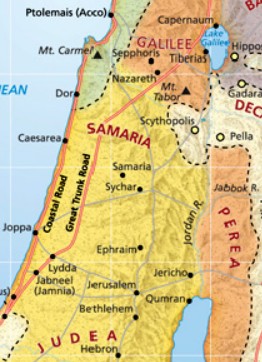
INTRODUCTION: When Jesus met the Syrophoenician woman whose daughter was demon possessed, He told her that it was not right to take the children’s bread and give it to the dogs, but when He spoke to the Samaritan woman at the well, He acted as if she had every right to the same spiritual gifts that He was giving to the Jewish people. He seemed to make no difference between Samaritans and Jews. Why? Who were these people? They were not accepted as Jews, but they were not considered Gentiles either. Where did they come from? Why was there bad blood between the Samaritans and Jewish people?
Luke 10:25-37
(25) And behold, a lawyer stood up to put him to the test, saying, “Teacher, what shall I do to inherit eternal life?” (26) He said to him, “What is written in the Law? How do you read it?” (27) And he answered, “You shall love the Lord your God with all your heart and with all your soul and with all your strength and with all your mind, and your neighbor as yourself.” (28) And he said to him, “You have answered correctly; do this, and you will live.” (29) But he, desiring to justify himself, said to Jesus, “And who is my neighbor?” (30) Jesus replied, “A man was going down from Jerusalem to Jericho, and he fell among robbers, who stripped him and beat him and departed, leaving him half dead. (31) Now by chance a priest was going down that road, and when he saw him he passed by on the other side. (32) So likewise a Levite, when he came to the place and saw him, passed by on the other side. (33) But a Samaritan, as he journeyed, came to where he was, and when he saw him, he had compassion. (34) He went to him and bound up his wounds, pouring on oil and wine. Then he set him on his own animal and brought him to an inn and took care of him. (35) And the next day he took out two denarii and gave them to the innkeeper, saying, ‘Take care of him, and whatever more you spend, I will repay you when I come back.’ (36) Which of these three, do you think, proved to be a neighbor to the man who fell among the robbers?” (37) He said, “The one who showed him mercy.” And Jesus said to him, “You go, and do likewise.”
QUESTIONS
- Why was it more powerful that a Samaritan was the one to help the wounded Jew?
- Samaritans were despised, yet the Samaritan was obeying God better than the priest and the Levite.
- What do you know about the attitude of Jews to Samaritans in the New Testament?
- The Jews despised the Samaritans.
SUMMARY: If you were reading this parable as a devotional, it would be good to look at the spiritual lessons and try to apply them to your own life; however, there are times when you need to study the Bible in order to see how ideas are interconnected throughout the scriptures, so in this topical Bible study, I will not spend a lot of time digging for spiritual lessons. Instead, the purpose of this study is to develop a wealth of background information so that parables like the good Samaritan will have more meaning later on. First, let’s start with New Testament verses.
John 4:5-9
(5) So he came to a town of Samaria called Sychar, near the field that Jacob had given to his son Joseph. (6) Jacob’s well was there; so Jesus, wearied as he was from his journey, was sitting beside the well. It was about the sixth hour. (7) A woman from Samaria came to draw water. Jesus said to her, “Give me a drink.” (8) (For his disciples had gone away into the city to buy food.) (9) The Samaritan woman said to him, “How is it that you, a Jew, ask for a drink from me, a woman of Samaria?” (For Jews have no dealings with Samaritans.)
QUESTION:
- What does this passage tell you about the relationship between the Jews and Samaritans?
- A Jewish man would not ask for a drink of water from a Samaritan woman. Jews had no dealings with Samaritans.
John 8:47-49
(47) Whoever is of God hears the words of God. The reason why you do not hear them is that you are not of God.” (48) The Jews answered him, “Are we not right in saying that you are a Samaritan and have a demon?” (49) Jesus answered, “I do not have a demon, but I honor my Father, and you dishonor me.
QUESTIONS:
- What was the ultimate insult that the Jews could think of giving?
- You are a Samaritan. You have a demon.
- Did Jesus answer the insult about being a Samaritan?
- No, He only addressed the idea of having a demon. Jesus did not consider being called a Samaritan as an insult.
Luke 9:52-56
(52) And he sent messengers ahead of him, who went and entered a village of the Samaritans, to make preparations for him. (53) But the people did not receive him, because his face was set toward Jerusalem. (54) And when his disciples James and John saw it, they said, “Lord, do you want us to tell fire to come down from heaven and consume them?” (55) But he turned and rebuked them. (56) And they went on to another village.
QUESTIONS:
- Why did the people of the Samaritan village reject Jesus?
- He was going to Jerusalem.
- How did these Samaritans feel about sharing Jesus with the Jews?
- They were jealous. They felt that Jesus had to choose between the Jews and the Samaritans. He could not have their loyalty if He was choosing Jerusalem over Samaria.
- Why was the reaction of James and John so extreme?
- They thought that the Samaritans should feel grateful that Jesus and the disciples had condescended to interact with them. James and John were outraged at the rejection because they felt it was doubly an insult that the lowly Samaritans would treat Jesus like this when He had gone out of His way to treat Samaritans with respect.
SUMMARY: The Samaritans were prejudiced against the Jews. The Jews seemed to hate the Samaritans more than they hated the Gentiles, but where did this hatred come from? To answer these questions, look at the origins of the Samaritans in the Old Testament.
1 Kings 12:1-19
(1) Rehoboam went to Shechem, for all Israel had come to Shechem to make him king. (2) And as soon as Jeroboam the son of Nebat heard of it (for he was still in Egypt, where he had fled from King Solomon), then Jeroboam returned from Egypt. (3) And they sent and called him, and Jeroboam and all the assembly of Israel came and said to Rehoboam, (4) “Your father made our yoke heavy. Now therefore lighten the hard service of your father and his heavy yoke on us, and we will serve you.” (5) He said to them, “Go away for three days, then come again to me.” So the people went away. (6) Then King Rehoboam took counsel with the old men, who had stood before Solomon his father while he was yet alive, saying, “How do you advise me to answer this people?” (7) And they said to him, “If you will be a servant to this people today and serve them, and speak good words to them when you answer them, then they will be your servants forever.” (8) But he abandoned the counsel that the old men gave him and took counsel with the young men who had grown up with him and stood before him. (9) And he said to them, “What do you advise that we answer this people who have said to me, ‘Lighten the yoke that your father put on us’?” (10) And the young men who had grown up with him said to him, “Thus shall you speak to this people who said to you, ‘Your father made our yoke heavy, but you lighten it for us,’ thus shall you say to them, ‘My little finger is thicker than my father’s thighs. (11) And now, whereas my father laid on you a heavy yoke, I will add to your yoke. My father disciplined you with whips, but I will discipline you with scorpions.’” (12) So Jeroboam and all the people came to Rehoboam the third day, as the king said, “Come to me again the third day.” (13) And the king answered the people harshly, and forsaking the counsel that the old men had given him, (14) he spoke to them according to the counsel of the young men, saying, “My father made your yoke heavy, but I will add to your yoke. My father disciplined you with whips, but I will discipline you with scorpions.” (15) So the king did not listen to the people, for it was a turn of affairs brought about by the LORD that he might fulfill his word, which the LORD spoke by Ahijah the Shilonite to Jeroboam the son of Nebat. (16) And when all Israel saw that the king did not listen to them, the people answered the king, “What portion do we have in David? We have no inheritance in the son of Jesse. To your tents, O Israel! Look now to your own house, David.” So Israel went to their tents. (17) But Rehoboam reigned over the people of Israel who lived in the cities of Judah. (18) Then King Rehoboam sent Adoram, who was taskmaster over the forced labor, and all Israel stoned him to death with stones. And King Rehoboam hurried to mount his chariot to flee to Jerusalem. (19) So Israel has been in rebellion against the house of David to this day.
QUESTIONS:
- How did the kingdom of Israel become divided into the northern kingdom and the southern kingdom?
- Solomon’s son refused to listen to the people, so they followed a different king.
- Who was left to follow David’s family’s leadership?
- The people of Israel who lived in the cities of Judah. This was basically the tribes of Judah and Benjamin (1 kings 12:21). The other ten tribes set up their own kingdom.
SUMMARY: King Jeroboam became king of Israel and Rehoboam was king of Judah. Israel became divided. Jeroboam was afraid that he would lose power if he let the people go on their annual pilgrimages to the temple in Jerusalem, so he set up an idolatrous worship system. In this way, the kingdom of Israel rejected not only the kingship of Solomon’s son, but they also rejected Yahweh. Not all of them did though. God continued to send His prophets to the northern kingdom, as well as the southern kingdom with messages of love, but they kept rejecting Him until finally He let them go. The capital of the southern kingdom of Judah was Jerusalem. The capital city of the northern kingdom of Israel was Samaria. Thus, the first Samaritans were the northern ten tribes who rejected Solomon’s son as their king.
2 Kings 17:21-23
(21) When he had torn Israel from the house of David, they made Jeroboam the son of Nebat king. And Jeroboam drove Israel from following the LORD and made them commit great sin. (22) The people of Israel walked in all the sins that Jeroboam did. They did not depart from them, (23) until the LORD removed Israel out of his sight, as he had spoken by all his servants the prophets. So Israel was exiled from their own land to Assyria until this day.
QUESTIONS:
- What happened to Israel when God rejected them?
- They were exiled from their own land and taken to the land of Assyria.
BACKGROUND: It was common practice for Assyria to conquer a land and export its people to another location within the Assyrian empire. This cut down on problems of rebellion. When people were in a strange new place where the customs and language were different, they were less able to unite and form a resistance against their overlords.
2 Kings 17:24-34
(24) And the king of Assyria brought people from Babylon, Cuthah, Avva, Hamath, and Sepharvaim, and placed them in the cities of Samaria instead of the people of Israel. And they took possession of Samaria and lived in its cities. (25) And at the beginning of their dwelling there, they did not fear the LORD. Therefore the LORD sent lions among them, which killed some of them. (26) So the king of Assyria was told, “The nations that you have carried away and placed in the cities of Samaria do not know the law of the god of the land. Therefore he has sent lions among them, and behold, they are killing them, because they do not know the law of the god of the land.” (27) Then the king of Assyria commanded, “Send there one of the priests whom you carried away from there, and let him go and dwell there and teach them the law of the god of the land.” (28) So one of the priests whom they had carried away from Samaria came and lived in Bethel and taught them how they should fear the LORD. (29) But every nation still made gods of its own and put them in the shrines of the high places that the Samaritans had made, every nation in the cities in which they lived. (30) The men of Babylon made Succoth-benoth, the men of Cuth made Nergal, the men of Hamath made Ashima,(31) and the Avvites made Nibhaz and Tartak; and the Sepharvites burned their children in the fire to Adrammelech and Anammelech, the gods of Sepharvaim. (32) They also feared the LORD and appointed from among themselves all sorts of people as priests of the high places, who sacrificed for them in the shrines of the high places. (33) So they feared the LORD but also served their own gods, after the manner of the nations from among whom they had been carried away.(34) To this day they do according to the former manner. They do not fear the LORD, and they do not follow the statutes or the rules or the law or the commandment that the LORD commanded the children of Jacob, whom he named Israel.
QUESTIONS:
- If there were not any descendants of Israel living in Samaria, who was living there?
- The king of Assyria brought in people from other areas, including Babylon, Cuthah, Avva, Hamath, and Sepharvaim.
- Did any of these people serve Yahweh before they were resettled in Samaria?
- No, they were idol worshippers, and they did not know anything about Yahweh.
- How did they learn to worship Yahweh?
- Lions were killing people. They interpreted this as a sign that they had offended the god of the land, so the king of Assyria sent one of the Jewish priests that he had resettled in Assyria with orders to teach the people how to worship Yahweh so that Yahweh would stop sending lions to kill them.
- How did the Samaritans worship after the priest taught them about Yahweh?
- They served Yahweh, but they also kept worshipping their own idols.
SUMMARY: Essentially, the new Samaritans were doing the same thing as the old Jewish Samaritans had before them. The new Samaritans had a strange combination of truth and lies. They worshipped Yahweh, but they also worshipped the various gods of their home countries in despicable ways including child sacrifice, which was one of the reasons that God had rejected the Jewish Samaritans and later sent the southern kingdom of Judah into exile. However, there was an essential difference. The Jewish Samaritans had known the truth about Yahweh at one time. Their society had descended from pure worship to total rebellion. The Gentile Samaritans were coming out of the depths of ignorance into the light of the knowledge of God. They were on their way out of darkness, not descending into it.
BACKGROUND: Fast forward about a hundred years. The people of Judah had been taken into exile by the Babylonians under Nebuchadnezzar. This was the time of Shadrach, Meshach, and Abednego in the fiery furnace. Later, the Babylonians were conquered by the Medo-Persians. The stories of the handwriting on the wall and Daniel in the lion’s den took place during this time. Control of the former land of the Jews had been transferred to the Persian kings. The first king, Cyrus the Great, had given permission for the Jews to return to their homeland and rebuild their city and temple, but some problems developed because of the neighboring Samaritans.
Ezra 4:1-6
(1) Now when the adversaries of Judah and Benjamin heard that the returned exiles were building a temple to the LORD, the God of Israel, (2) they approached Zerubbabel and the heads of fathers’ houses and said to them, “Let us build with you, for we worship your God as you do, and we have been sacrificing to him ever since the days of Esarhaddon king of Assyria who brought us here.” (3) But Zerubbabel, Jeshua, and the rest of the heads of fathers’ houses in Israel said to them, “You have nothing to do with us in building a house to our God; but we alone will build to the LORD, the God of Israel, as King Cyrus the king of Persia has commanded us.” (4) Then the people of the land discouraged the people of Judah and made them afraid to build (5) and bribed counselors against them to frustrate their purpose, all the days of Cyrus king of Persia, even until the reign of Darius king of Persia. (6) And in the reign of Ahasuerus, in the beginning of his reign, they wrote an accusation against the inhabitants of Judah and Jerusalem.
QUESTIONS:
- What were the returning exiles doing?
- Rebuilding the temple
- What two tribes were building the temple?
- Benjamin and Judah. Remember that these are the tribes who were following Solomon’s son.
- What does verse 2 tell you about the adversaries mentioned in verse one?
- They were the Gentiles who were brought to Samaria by the king of Assyria and taught to worship Yahweh, i.e. the new Samaritans
- What did the Samaritans want to do in verse 2?
- They wanted to help rebuild the temple
- Did the Jews accept the Samaritans’ help?
- No. The verse doesn’t say why, but you might try to come up with some reasons based on your knowledge of the Bible.
- What was the reaction of the Samaritans?
- They started doing everything they could to stop the building of the temple. They tried to intimidate the Jews and made them afraid to keep working on the temple. They bribed government officials to stop the Jews from continuing construction. They wrote a letter to the king to stop the temple from being built.
SUMMARY: The Jews felt that the Samaritans deserved their hatred because they had tried to keep them from rebuilding the temple and later the walls of the city of Jerusalem. The Jews were fighting for their lives as a people, and the Samaritans were trying to suppress them. Other negative interactions happened in the time between the end of the Old Testament and the coming of Jesus. In the end, the Jews let these conflicts lead them too far into hatred. They seemed to abhor the Samaritans even more than idol-worshipping Gentiles who knew nothing about the true God. The New Testament tells of how Jesus began to reverse this attitude.
Luke 17:15-19
(15) Then one of them, when he saw that he was healed, turned back, praising God with a loud voice (16) and he fell on his face at Jesus’ feet, giving him thanks. Now he was a Samaritan. (17) Then Jesus answered, “Were not ten cleansed? Where are the nine? (18) Was no one found to return and give praise to God except this foreigner?” (19) And he said to him, “Rise and go your way; your faith has made you well.”
QUESTION:
- What was Jesus’ response to the Samaritan leper?
- He healed the Samaritan leper at the same time that He healed the Jewish lepers. He commended the Samaritan’s faith.
Acts 1:8
(8) But you will receive power when the Holy Spirit has come upon you, and you will be my witnesses in Jerusalem and in all Judea and Samaria, and to the end of the earth.”
QUESTIONS:
- What was the order that God would give the gospel in?
- First Jerusalem, Second Judea and Samaria, and third to the world.
- What does this tell you about how Jesus thought about Samaria?
- To Him they were not Gentiles even though they were descended from Gentiles. When the Samaritan woman was speaking to Jesus, she talked of Jacob as her ancestor (John 4:9) even though the Samaritans were not related to him by blood. By the time of Jesus, the Samaritans had become children of Jacob also. God does not look at blood, but faith.
CONCLUSION: The Samaritans evolved and grew in their faith over time. Satan must have thought that he had won when he lured the northern kingdom Jews into apostasy and idol worship so that God allowed Assyria to remove them from the land. He probably felt that his triumph was complete when the king of Assyria replaced all the Jews in Samaria with idol-worshipping Gentiles. However, God was not defeated. He took these misfit Gentiles and slowly drew them to Himself, using their own superstitions to bring a priest in to teach them to follow the true God and working with them through their times of hostility and active warfare against His returning Jewish followers until they gave up their idol worship and followed Yahweh with the little light that they had. (They only accepted the Pentateuch–the five books of Moses.) Then Jesus set up a meeting with a woman at a well, and the light of His truths blazed across their land. The Samaritans received that light with tremendous joy.
John 4:42
(42) They said to the woman, “It is no longer because of what you said that we believe, for we have heard for ourselves, and we know that this is indeed the Savior of the world.”